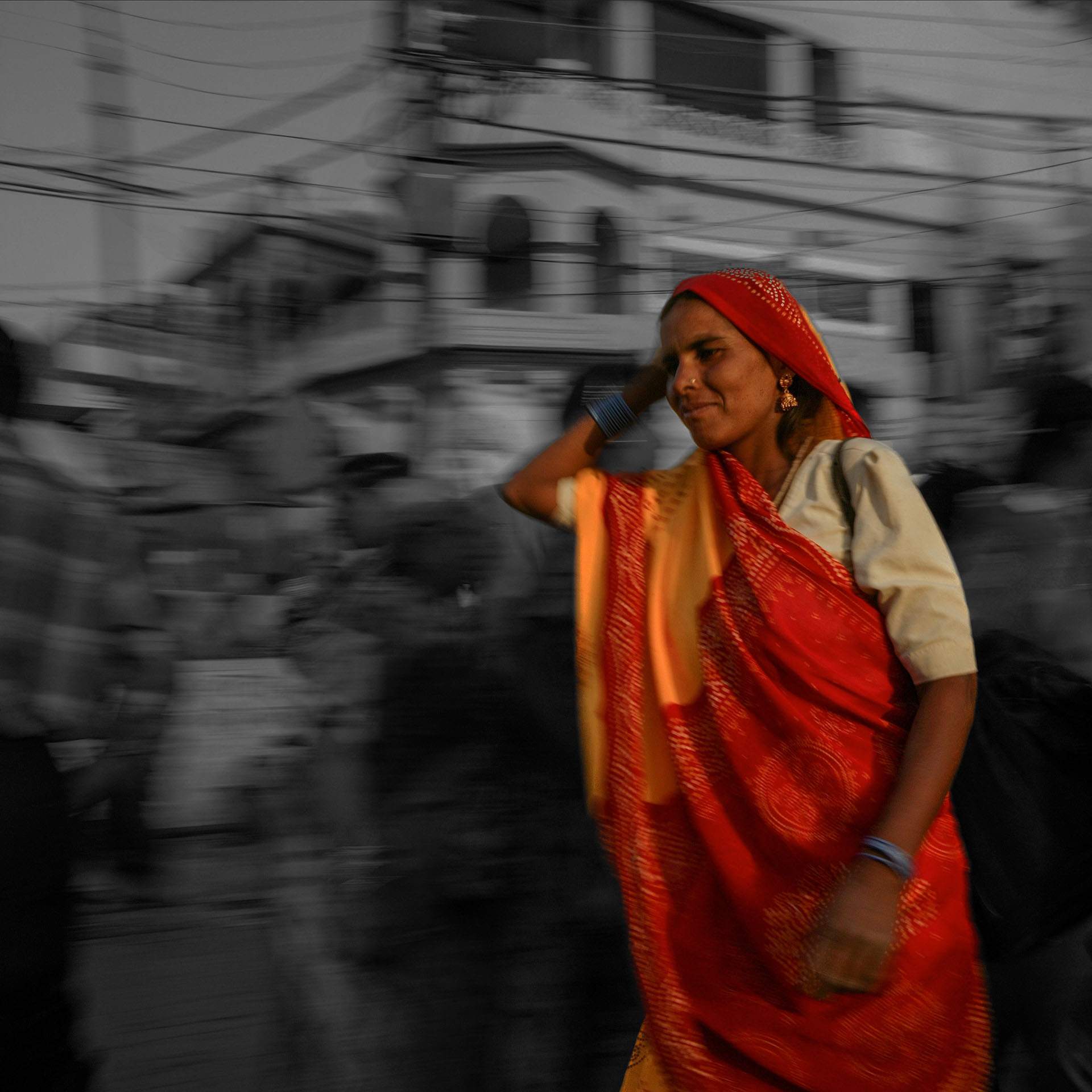
Devadasi Virtual Prayer Walk

Pray with us for the devadasis – women dedicated for service to a Hindu goddess, and trapped in temple prostitution.

Devadasi Virtual Prayer Walk
Runtime
5:17
View count
114

Week of October 30, 2011

October 30 : Students make a difference. “We are thanking the Lord for enthusiastic new teammates who are already eagerly engaging women in Assam. They have quickly become friends with some young women in the community. One of the teammates routinely visits S, the young wife of an auto rickshaw driver who has a 3-year-old son. The other enjoys spending time with R, a young married woman who longs to make a decision for Jesus but lacks her family’s support. Pray for these women as they strengthen their relationships with their national friends and seek opportunities to share Jesus with them. Pray for S to understand the importance of a relationship with the true Savior and for R to have the boldness to follow Him despite her family’s disapproval.”

October 31 : Kidnapped for Ransom.  Media in Bihar state reported on September 1 that a girl in her late teens was kidnapped for ransom on August 30 from her college campus during her first day of college. “Kidnapping for ransom has increased manifold in Bihar in the last few months,” one online newspaper reported. “School and college going boys and girls are the main target. Several of these cases have ended up in ghastly murder.” One’s first day of college should be a time of celebration and hope. Please pray that officials will find those who have been abducted and that kidnappers will be held accountable. Give thanks that God sees those who are in distress. Pray, too, that plans for future abductions will be thwarted. Pray that this fall, many college students in Bihar will call upon the name of the Lord, receive salvation through Jesus, and celebrate their newfound hope. BihariBride@pobox.com

November 1 : Certificates Received. Thank you for praying for a teaching course that a cross-cultural representative wrote on how to reach the Muslims of northern India with the Good News of Jesus. During the summer, seven people who attended the course in Bihar – meeting two days a month for six months – received certificates of completion. “Some of them are doing a very good job in ministry, and each one has a heart for Muslims,” the cross-cultural representative said. He since has been asked to start another course this fall and to do a follow-up meeting as well with these who have completed the first course. Please pray that those who attended the first course will use the knowledge that they have gained for the glory of God. Pray that God will lead to the second course those whom He Himself has chosen. Bihar had nearly 83 million people at the time of the 2001 census. BihariBride@pobox.com

November 2 : Strange Peace. “Pray for a family who has been attending our local house fellowship. The wife, R, has been a growing disciple for the past year, and she is teaching her three children about Jesus. As a direct answer to prayer, her husband, M, has recently started attending the fellowship and is experiencing ‘a strange peace’ he has never felt before. They are all from a Hindu background. Pray that M’s faith in Jesus will grow and that he will begin to lead his family in Jesus’ footsteps. Pray that the Father will use this family to bring many more into His kingdom.”

November 3 : Post Traumatic Stress. “Sometimes I have such dark dreams and such severe depression that I have to ask my boss to leave work on account of my crying,” said Ami (pseudonym), an educated and wealthy government teacher in the valley. Statistics say that more than 80 percent of Kashmir deals with some form of post-traumatic stress, depression, or mental illness. The effects of more than 20 years of militancy and violence have taken their toll on the minds and hearts of ordinary people who are sincerely searching for peace. Some of those struggling with depression have received Bibles or have heard the Gospel message. Jesus said, “I am leaving you with a gift – peace of mind and heart. And the peace I give isn’t like the peace the world gives. So don’t be troubled or afraid” (John 14:27, NLT). Pray that His peace will penetrate the darkness and bring complete deliverance for all those in Kashmir drowning in anxiety or depression.

November 4 : Equipping Leaders. In September, a training was held to equip pastors and lay leaders in using biblical stories for evangelism and church planting. Pray for those who attended to be obedient to God and proclaim His kingdom through what they have learned. Pray that people they share with will respond to the Gospel and that new churches will be started.

November 5 : Partners Found. “The harvest is plentiful . . .” and workers are coming out of it! Many national partners are ready to branch out on their own: whether in ministry, in starting a church in their home, or in sharing their faith on their own. Please pray for the bold believers in Mumbai who have answered the call and are entering the harvest as laborers of love.


Reaching India’s IT through stories

By Caroline Anderson

The blue Skype icon bounces on the bottom of Lekha Katti’s* computer screen. When this Information Technology [IT] professional’s verse of the day arrives via an inter-office instant message, she copies the verse to her Facebook profile. Katti hopes her coworkers will also notice the Bible verse on her desktop when they pass her cubicle so she can share her new favorite Bible story: Daniel and the lions.

Bangalore is known internationally as the Silicon Valley of India because it holds a position as India's leading IT exporter.

This young believer, who works for a major IT company in Bangalore, India, has a heart for sharing the gospel with her peers in the IT business. IT professionals often feel torn between traditional Hindu culture and Western culture because they’ve had so much exposure to the West.

Katti’s coworkers are well-educated, high-caste Hindus. (Castes in India define social, financial and religious status.) Katti’s Indian peers work for top international IT companies like Hewlett-Packard, Siemens and Infosys. Many grew up speaking English and have worked abroad in the U.S. or U.K.

While at work, women who work in the IT business dress like Westerners in jeans and T-shirts. Outside of these insular neighborhoods of IT professionals, however, the women forsake their jeans for saris. “It’s like they are living in between two worlds,” says Margot Gladding,* an IMB representative in Bangalore.

On the surface, the IT community has a Western mindset. Many claim to be agnostic, but most turn back to Hindu gods in a crisis or to find a spouse. Many high-caste Hindus come from the priestly caste, so leaving their heritage isn’t easy.

“[These people] are a third culture and they’re a changing culture,” Gladding says.

IT companies in India employ two million workers, and the country has 10 million IT-related jobs, Britain’s New Statesman reports. Katti’s demographic is therefore an important group of people for Christians to understand and address. That’s why Margot Gladding and her husband Carver* share the story of Daniel and the lions’ den.

Everyone loves stories

The ministry of the Gladdings, native Texans, focuses on storytelling and on equipping other IMB representatives to share Bible stories with the people of South Asia.
“Hi, I’m your new neighbor,” Gladding says to a neighbor, offering an egg-less cookie — most high-caste Hindus are vegetarian.

In addition to making friends face-to-face, Gladding also ministers using technology. She sends mp3 files of Bible stories to Katti and other believers’ cell phones using Bluetooth. Katti and other IT professionals often listen to the stories and podcasts on the community bus to work.

The increasing ease of digital file-sharing means that a growing number of Katti’s coworkers also now listen to Gladding’s stories on their commute — and share with their friends in turn.

Katti is becoming bolder with every Skype chat and Facebook wall post. She knows she can make a difference in her nation just like Daniel did in his.

*Name changed.

FIRST PERSON: “Excuse me. Do you worship the living God?”

By Skylar Pippin*

DELHI, India–Recently, I have realized 4-year-old Chauncey* has grown more aware of the idols located in the homes of friends we visit. He started out by running up to them and yelling back to me, “Look Mom! They have idols!” or he would say out loud to me something like, “Why do they have idols?”

Honestly, it began to make me feel uncomfortable because I didn’t know how to handle the situation. My friends would just look at me with confusion as to why this was so strange to Chauncey, as if to say, “Don’t all people have idols in their homes?”

Every time we’d leave, I’d try to explain to Chauncey that this is one of the reasons we are in India. Many people do not know the truth about who God is and how He desires for them to worship Him. What they worship is not alive, but we know that our God is alive and desires for all people to know and love Him. Chauncey would just smile and say OK.

A few days ago, we visited my newest friend Sonika.* As we entered her house, a large idol was in the entryway. My son looks it over and then goes straight to Sonika and says, “Excuse me, Sonika. Do you worship the living God?” Once again, I felt flustered.

Sonika looked at me confused. “What did he say?” I quickly and quietly told Chauncey, “It’s OK, honey. It’s OK. Just go play.” Then I apologized for Chauncey, and we moved on with the visit, while Chauncey walked away a little sad.

When we got home, I tried to explain to Chauncey that it’s hard when he asks people questions about their idols, because they don’t even know they don’t know the truth. I suggested that whenever we visit someone and he sees their idols, then he could pray for them to come to know Jesus. He said, “Ok, we need to pray right now for ….” He listed off all his friends, and we prayed. I left feeling pretty good about the situation.

Later that evening, however, I was still processing everything, and I started feeling sick, ashamed. First, how could I have told my son it’s OK? Of course, it’s not OK. That’s why we’re here, isn’t it? Because it’s not OK! It hurts God. It makes Him angry. No, it’s not OK. What’s more, it’s not OK that I apologized for my son who was asking a question that I should have been asking but didn’t because I felt awkward since Sonika and I were just beginning our friendship. Oh how I pray that I will never again apologize for my son asking thought-provoking questions about their belief in God.

Again, I went to Chauncey, confessed and apologized. I tried to explain that God is still teaching me. What I told him earlier about just praying was right and good, but he didn’t need to stop there. It was a great thing that he was asking people about God. It is very important, because we want all people to know God.

Thankfully, our God is a faithful Father who is ever teaching us, even as we are trying to teach our children. I never realized how much of Chauncey and 2-year-old Hayley’s spiritual foundation is forming right now. If I teach my kids that we don’t bring up these issues in public, that we just “pray” for them, that’s not enough. Yes, our God does answer prayer, but He also tells us to go and tell. Please pray for us to have wisdom when training our children.

Pray also that we will not reproduce tolerant Christians, but bold faithful witnesses. I told Chauncey it was “OK” just to keep him quiet, but we both knew it was not OK. I don’t ever want to compromise because I am a little uncomfortable with the timing. Instead, I pray that I would be prepared and able to share with my friends after Chauncey asks his questions. What great opportunities!

–30–

*Name changed.

Skylar Pippin and her husband, Dakota,* serve among South Asian peoples with the Southern Baptist International Mission Board.

Maldives Arrests, Deports Indian Teacher for Owning Bible

Maldives Arrests, Deports Indian Teacher for Owning Bible Island nation cracks down on preaching unofficial Islam, non-Islamic faiths.

By Vishal Arora

Compass Direct News, October 21, 2011: www.compassdirect.org

Maldives parliament building.

NEW DELHI, October 21 (Compass Direct News) – Police in the island nation of Maldives held a teacher from India for about 15 days before deporting him on Oct. 14 for having a Bible in his house, a source said.

Shijo Kokkattu, a 30-year-old Catholic and teacher at the Raafainu School in Raa Atoll, had been arrested in late September after police found a Bible and a rosary in his house during a raid, a foreign source in the capital city of Male told Compass by phone.

Charging that Kokkattu was preaching his Christian faith in the Muslim nation, which recently tightened restrictions on preaching and practice of non-Islamic faiths, police took him to another island for interrogation and kept him in custody for more than two weeks, said the source, who requested anonymity.

Police raided his home after Kokkattu’s colleagues found Christian materials on a school computer he had used and reported it to authorities. While downloading material from his pen drive, Kokkattu had mistakenly downloaded some Catholic songs in the Malayalam language (used in a south Indian state) and a picture of the Virgin Mary.

“The videos were in Indian, so I don’t know what they were saying, but the images were Christian,” school principal Mohamed Shiraj told Minivan News, an independent news portal based in the Maldives.

Kokkattu, a parishioner from Tellicherry Archdiocese in the south Indian state of Kerala, had been teaching at the school for two years.

“He was a very good teacher, we’ve not had any complaints of him in the past,” the principal reportedly said.

Last year, Maldivian authorities rescued another Christian teacher from India when Muslim parents of her students threatened to throw her into the sea for “preaching Christianity” after she drew a compass in class, which they alleged was a cross. (See www.compassdirect.org, “Muslims Force Expat Christian Teacher to Flee Maldives,” Oct. 5, 2010.)

The Maldives, a string of 1,190 islands boasting numerous white beaches in the Indian Ocean, is regarded as a tourist paradise visited by tens of thousands of Westerners each year. But it’s also a country that claims, like Saudi Arabia, that all of its more than 300,000 citizens are Sunni Muslims.

The country’s 2008 Constitution states that a “non-Muslim may not become a citizen of the Maldives.” Expatriates following other religions can practice their faith only individually and within their respective homes.

New Restrictions
Last month, the Ministry of Islamic Affairs published new regulations under the Protection of Religious Unity Act of 1994 in the government gazette, signaling a renewed commitment to control unlicensed preaching of Islam and propagation of non-Islamic religions in the country.

The Act outlaws promotion of anything that represents a religion other than Islam or any opinion that disagrees with Islamic scholars. It also prohibits use of any website, blog, newspaper, or magazine that contradicts Islam. Any violation under the Act is punishable by an imprisonment of between two and five years, banishment or house arrest. Foreigners who are found proselytizing are to be deported, it says.

The new set of regulations maintains a longtime ban on propagation, display and expression of any religion other than Islam. It also prohibits translation of books with such content into the local language, Dhivehi.

The regulations state that only preachers licensed by the government are allowed to speak in public, and they must not create hatred towards people of any other religion – the latter stipulation has been criticized by members of Islamic organizations such as the Islamic Foundation of Maldives, who say that because the Quran speaks against Judaism and Christianity, they too should have the right to do so.

The regulations require foreign scholars to abstain from criticizing Maldives’ social norms, domestic policies or laws. And media must not disseminate any information that “humiliates Allah or his prophets or the holy Quran or the Sunnah of the Prophet [Muhammad] or the Islamic faith.”

The nation’s tight control over religion is seen as a legacy of former authoritarian President Maumoon Abdul Gayoom, who ruled for 30 years until 2008, keeping religion and its institutions under his grip. He was particularly known for insulating the country against Wahhabi influence from Saudi Arabia and for checking alleged missionary activities by Christians.

President Mohamed Nasheed seeks to deviate from Gayoom’s policies but has not been able to introduce any major reforms or ensure religious freedom. Any advocacy for individual rights is seen as a Western conspiracy to attack Islam in the country. Maldivian conservatives do not allow citizens to become atheists, and leaving Islam can attract violence and harassment by authorities.

Nasheed’s moderate Maldivian Democratic Party does not have a majority in the parliament. In 2009, the main opposition party, the Maldivian People’s Party led by Gayoom, won a majority in the parliamentary election.

Decades of carefully exercised political control over religious narrative in the Maldives has left in its wake a culture of intolerance among the general public unsympathetic to wider views on non-Islamic religions and hostile to Islamic academics and Muslim religious scholars who espouse a more humane form of Islam.

A Minivan author wrote last month that many Maldivian lawmakers and senior government officials privately admit “their hands are tied when it comes to the issue of freedom of religion.” The author asserted that advocating universal human rights “is the easiest way of committing political suicide in the Maldives.”

www.compassdirect.org

END

**********
Copyright 2011 Compass Direct News. Used by permission.

My two birthdays

By Goldie Frances*

I have two birthdays. My favorite way to celebrate my physical birthday is with my family, and I was blessed to do just that a little early while in the states this July. On my actual birthday, I was flying back to South Asia. Later that day, I rode several hours across the country, quietly wishing all the while that my birthday would be topped off by a visit with my closest neighbors, precious Muslims friends. I didn’t plan to tell them it was my birthday; I just wanted to reconnect and catch up with them. I never really prayed specifically for that to happen, but praise God that He hears even our wishes!

I hadn’t even turned the key in the door when “Jazz” appeared. Right away, she and her older brother were sitting in my apartment chatting. When they realized I had not eaten, they brought dinner to me on a tray. Then Jazz just happened to ask when my birthday was. I hesitated before confessing, “It’s today.” They sprang into action and soon all four children and their mother there with birthday cake singing Happy Birthday!

They couldn’t find candles on such short notice, but they told me to close my eyes and make a wish anyway. “But my wish already has come true,” I said. “My wish was to spend the evening with you.” They insisted that make another, so I closed my eyes and prayed for the salvation of this dear Muslim family.

Everyone left, and I had begun to clean up smeared icing and spilled water – laying books out to dry – when the doorbell rang. Jazz, 16, had lost her ring. We searched but could not find it. Then she noticed a book on the table. “Is this a book about Jesus Christ?” “Yes.” “Can I borrow it?” “Yes.” “He’s one of our prophets you know.” “Yes.” Incredible! God had heard the wish I prayed only an hour earlier and already was at work!

—30—

*Name changed.

Misspelling ‘Muhammad’ puts Pakistani schoolgirl in danger

Baptist Press, Oct 5, 2011: http://www.bpnews.net/BPnews.asp?ID=36265

By Staff

LAHORE, Pakistan (BP) — An eighth-grade student in Pakistan has been expelled from school and her family forced to relocate after the Christian girl misspelled “Muhammad,” leading to accusations of blasphemy, sources told Compass Direct News.

In Abbottabad, 13-year-old Faryal Bhatti, a student at the Sir Syed Girls High School in Pakistan Ordnance Factories (POF) Colony Havelian, misspelled a word on an Urdu exam Sept. 22 while answering a question on a poem in praise of the Muslim prophet Muhammad, according to area Christians. Urdu is a language.

Faryal wrote laanat, the transliteration of the Urdu word for “curse,” instead of naat, which means a poem written in praise of Islam’s prophet, they said. The school administration and local Islamists declared that the error was serious enough to violate Pakistan’s widely condemned laws against blaspheming Muhammad and Islam.

Conviction under Section 295-C of Pakistan’s blasphemy law for derogatory comments about Muhammad is punishable by death, though life imprisonment also is possible.

Faryal’s Urdu teacher was collecting the answer sheets from her students when she noticed the word on Faryal’s paper. The teacher, identified only as Fareeda, summoned the Christian girl, scolded her and beat her, area sources told Compass by telephone.

Fareeda then notified the principal, who in turn informed school officials as news of the error spread throughout the colony. The next day, male students at the school as well as some Muslim representatives staged a demonstration, demanding registration of a criminal case against the eighth-grader and her eviction from the area, sources said.

Prayer leaders within the Muslim community also condemned the incident in their Friday sermons, asking the colony’s administration to take action against Faryal as well as her family, sources said.

POF Colony Havelian Managing Director Asif Siddiki called a meeting of clerics and school teachers to discuss the conflict, according to reports, at which the girl and her mother were ordered to appear; they explained that it was a mere error caused by a resemblance between the two words.

The girl and her mother immediately apologized, contending that Faryal had no malicious intentions, but in a move apparently designed to pacify Muslim cries for punishment, the POF administration expelled her from the school Sept. 24.

School administrator Junaid Sarfraz said Faryal had confessed that she had inadvertently made the mistake and the school administration, after consulting local clerics, decided to expel her. Sarfraz claimed that Faryal’s teacher was certain that she had made the mistake intentionally and that the matter was referred to clerics because Faryal had previously aroused similar suspicions of blasphemy.

Maulana Alla Dita, head of the area’s prominent mosque, reportedly said the school administration had made the right decision in expelling Faryal from school. Dita claimed that he had met with Faryal, who had apologized for the mistaken use of the word. Dita said he wasn’t clear about Faryal’s intentions, but that “the word she had used was sacrilegious,” according to press reports.

Faryal’s mother, Sarafeen Bhatti, a staff nurse at the POF Hospital Havelian for several years, immediately was transferred to POF Wah Cantonment Hospital. Abbottabad District Commissioner Syed Imtiaz Hussain Shah said the 13-year-old had been expelled for using “derogatory words” and her mother had consequently been “moved to another place.”

A Christian lawyer in Havelian who was among the community members making efforts to defuse area tensions told Compass by phone that the military had acted swiftly to save the lives of Faryal and her mother.

“The military swung into action soon after protests broke out calling for a blasphemy case against the teenager,” the attorney said on condition of anonymity. “They bundled the family in an ambulance and took them away before the situation could turn violent.”

A text message campaign also started Sept. 24, calling for action against the family, he said.

“Some Christian families living in the area panicked, but the situation has been under control so far,” he said.

An area Christian told Compass there were 13 or 14 Christian families in the colony who now have fears about security. He said Faryal’s family had little contact with other Christians living in the area. The resident also praised the army for acting in a timely manner, “or else the mullahs would have punished all of us for the little girl’s error.”

The incident has instilled fear in Christian parents that an unintentional mistake by their children could cause them personal disaster. Shazia Imran, mother to three schoolchildren, told Compass that Faryal’s episode had left her distressed.

“Ever since I came to know about the young girl’s story, I have been unable to sleep properly,” she said. “We have been continuously telling our children not to discuss their faith with anyone in school and to avoid getting into religious discussions with their Muslim class fellows, but this was beyond my imagination.”

She added that she and her husband were now “very disturbed and fearful” about their children’s future in Pakistan.

Azra George, a Christian mother to a college student, said the incident had shocked her and the congregation at her Presbyterian church.

“Everyone at church was discussing this sorry incident on Sunday,” she said. “Parents of school-going children were particularly perturbed. This blasphemy thing will always remain hanging on our heads like a sword, and there’s nothing anyone can do about it.”

Compass’s repeated attempts to reach the Bhatti family were unsuccessful as they had moved to an undisclosed location because of security concerns.

Asif Aqeel, executive director of the Community Development Initiative, an affiliate of the European Centre for Law and Justice, said the incident showed how Pakistani society was getting sensitized over the issue of blasphemy.

“Only a small number of people are formally accused of blasphemy. We do not know the number of people who, like Faryal and her family, are harassed without a legal charge,” he said. “Members of Pakistan’s minority communities are afraid of moving around and expressing themselves freely due to the fear of being accused of blasphemy.”

Christians make up only 2.45 percent of Pakistan’s population, which is more than 95 percent Muslim, according to Operation World.    Aqeel said a Christian boy recently was implicated in a criminal case of harassment by the family of a Muslim girl who was in love with him. Aqeel said the boy’s family urged the police investigating officer to free the boy, whose name was withheld for security reasons, as the charges were baseless.

“The family was taken aback when the police official told them that their son had mocked the Sunnah [sayings and teachings] of prophet Muhammad by keeping a French beard,” Aqeel said. Thus, although the harassment case had nothing to do with the blasphemy law, the mere mention of the law forced the family to keep silent, he said.

Similarly, Christian teachers avoid lessons that mention Islamic history or anything related to the religion out of fear that any misstep could bring criminal charges. Likewise, Urdu language and social studies textbooks include several lessons on Islamic religious thought, so Christian teachers avoid nearly half of these books to avoid being charged with blasphemy, he said.

Napolean Qayyum, a leader of the Minorities Wing of the ruling Pakistan People’s Party, condemned the incident, saying it was unfortunate that a 13-year-old had to suffer this ordeal over a miniscule error.

“The army’s timely intervention saved the Christians’ lives, but most people are not so fortunate,” he said, adding that the incident showed how intolerance towards minorities was taking root in Pakistani society.

“Would the teacher have highlighted the same mistake if it was made by a Muslim student?” he said. “I would guess not.”

–30–

Written by Compass Direct News, a California-based news service focusing on the persecuted church. Used by permission.

TRUSTEES: Slain Pakistani honored by ERLC

Baptist Press, Sep 19, 2011: http://www.bpnews.net/BPnews.asp?ID=36151

By Dwayne Hastings
NASHVILLE (BP) — Clement Shahbaz Bhatti, Pakistan’s minister for minority affairs and the only Christian serving in that government, was posthumously awarded the 2011 John Leland Religious Liberty Award by the Southern Baptist Ethics & Religious Liberty Commission during the Sept. 12-13 meeting of ERLC’s trustees.

Bhatti, who was assassinated March 2 of this year, was a “man of incredible bravery” who fought for religious liberty in Pakistan at “great personal risk,” ERLC President Richard Land said.

According to press reports, in a videotape unsealed after his death, Bhatti said: “When I’m leading this campaign against the Sharia law, for the abolishment of [the] blasphemy law and speaking for the oppressed and marginalized persecuted Christian and other minorities, these Taliban threaten me, but I want to share that I believe in Jesus Christ, who has given His own life for us.”

According to The Guardian newspaper, the men who attacked Bhatti’s car as he drove to his office left behind pamphlets scattered on the street that called Bhatti an “infidel Christian,” pillorying him for his vocal criticism of the country’s blasphemy laws aimed at silencing all but Muslims.

Land said he hopes the award will honor Bhatti’s memory and help “perpetuate what he stood for.” He commended the late Christian Pakistani for his vision for soul freedom.

PERSECUTION RISING

Land told the trustees that incidents of religious persecution are growing globally and Christians are increasingly being victimized.

“The bad news is that there are more Christians being martyred; the good news is that there are Christians in areas of the world where there didn’t used to be Christians,” Land said, noting the growth in the number of believers in places in the world where persecution is more common.

On a broader front, the world is seeing a “reverse domino effect” as citizens of nations in the Middle East and North Africa react to the seeds of democracy that are sprouting in Iraq, said Land, a member of the U.S. Commission for International Religious Freedom since 2001.

“For all of its problems, Iraq is the most democratic government and most representative government ever elected in the Arab world. Ever,” Land said.

“It is in our country’s best interest to do everything we can to help democracy grow in other countries in the region,” he continued.

Land also applauded the founding of a new nation, South Sudan, out of the violence and destruction sown in that area by what he called a “gangster regime in Khartoum,” Sudan’s capital.

South Sudan became an independent state on July 9 of this year after a tenuous peace was secured in an ongoing civil war.

“This is as primitive a country as any in the world,” Land said. “They have been bombed, slaughtered and mutilated for 15 years and it shows.”

Much of the fighting was over oil, which is in the south, Land said, noting the new nation will require the “world’s attention and assistance” to ensure the militants in Sudan don’t seek to retake the area.

Land said he is less than pleased with the state of affairs in Pakistan, where religious liberty is nonexistent. In its most recent report, the U.S. Commission on International Religious Freedom found that “Pakistan continued to be responsible for systematic, ongoing, and egregious violations of freedom of religion or belief.”

Religious liberty was the most frequently addressed topic in stories and interviews featuring the SBC entity, according to an ERLC analysis of media activity.

Trustees learned that Land and other ERLC staff conducted 192 media interviews in the past year, resulting in 3,417 news stories. The greatest percentage of “media hits” were online and in social media.

DISTINGUISHED SERVICE AWARD

Fred Luter, pastor of Franklin Avenue Baptist Church in New Orleans, received the 2011 Richard D. Land Distinguished Service Award during the meeting.

Luter was elected first vice president of the Southern Baptist Convention at the SBC annual meeting in June. He earlier served as the convention’s second vice president.

Luter performed the daunting task as a shepherd seeking his flock after Hurricane Katrina drove many of his church members to communities across the country, Land said.

In August 2005, Luter’s home and church were damaged by the floodwaters following the hurricane’s direct hit on New Orleans. Since then, the Franklin Avenue congregation has grown to 7,000-plus members.

Luter, who was born in New Orleans’ Lower Ninth Ward, a neighborhood hit particularly hard by the 2005 breach of the city’s levees, is one of only a few people who is successfully able to reach native New Orleans residents with the Gospel, Land said.

“Fred Luter richly deserves this award,” Land said, noting his work in spreading the Gospel and meeting needs.

VOTER REGISTRATION

Land told the trustees that evangelicals have more influence in Washington, D.C., than they have had in the 23 years since he became ERLC president, but many evangelicals are still not registered to vote. “That’s a disgrace,” Land added.

Land promised the Ethics & Religious Liberty Commission would be part of the “largest and most sustained effort yet in seeking to get Southern Baptists registered to vote, informed and encouraged to vote their values, beliefs and convictions.”

The outcome of the 2012 election, like all elections, has consequences for the nation, Land said. “We are at risk of being the first generation in American history to have passed on to our children a lower standard of living than the one we had,” Land lamented.

At the core of the 2012 election, he said, is the question: “Are we going to fundamentally alter the role the government plays in our daily lives, or not?”

In other business, trustees:

– elected Stephen Faith of New Albany, Ind., a retired associational missionary, as board chairman; Richard Piles, pastor of First Baptist Church in Camden, Ark., as vice chairman; and Donald Mason, a member of First Baptist Church in Locust Grove, Ga., as secretary.

– responded to motions referred from the 2011 Southern Baptist Convention, including a call to study the “impact of unbiblical sexuality.” In their response, trustees acknowledged the “great extent to which unbridled sexual deviancy has soiled society and ravaged families,” encouraging Southern Baptists to “establish clear, God-honoring guidelines in this area.”

– tapped David Allen, dean of Southwestern Baptist Theological Seminary’s school of theology, and David Jones, professor of Christian ethics at Southeastern Baptist Theological Seminary, as fellows of the ERLC’s Research Institute.

– approved a $3.108 million budget for the 2011-12 fiscal year, down 3.96 percent from the previous year. Staff salaries remain at their current levels in the budget. The ERLC receives 1.65 percent of Cooperative Program funds received nationally.

–30–

Dwayne Hastings is a vice president with the Ethics & Religious Liberty Commission of the Southern Baptist Convention. www.bpnews.net Used by permission.

Lessons learned via planes, trains and hikes

By Hudson Stanley*

KOLKATA, India–As the plane landed and the warm, Indian humidity hit my face, I was reminded of my purpose: keeping in touch with God’s will for me during this trip and my life in general.

Heading into the trip, I expected great things from God for those we went to minister to, but I never imagined that God would do so much in my life.

Our team consisted of amazing people who were on fire for the Lord! We did some very memorable things in places that I will never forget. India was truly incredible.

On the northbound overnight train we took from Kolkata and five-hour jeep ride up the mountain to the village God constantly reminded me of the sheer beauty of His creation.

To reach the village of Pakong, we hiked down the mountain in the cold pouring rain and as we did, God was really preparing me for the things I would encounter and do for the remainder of the trip. This trip wasn’t about me or even us as a team. This trip had a purpose of service to the families where we stayed as well as the many children we would encounter.

The mountains were breathtaking and the people were truly remarkable! The diversity of this culture was like nothing I have ever experienced. The village was dirty and it smelled, yet the people were still well dressed and kind and the food was spectacular.

Walking around the village, seeing the prayer flags, I became keenly aware of the overwhelming spiritual darkness of the area. I was there to share God’s hope and love to the hopeless.

Even though we didn’t have the luxuries of our everyday lives, there was assurance that the things we did could make a difference and have a greater impact on the people in the village.

The first night, as some of us sat around the table with a man named Top Den, I immediately noticed the hospitality they showed us. It was obvious that he and his family gave us the best they had to offer. This forced me to look at myself and truly examine how I, as a believer, am treating acquaintances and friends who visit in my home. Am I consistently sharing my greatest possession, Jesus, with those I meet?

Even after the first night on the ground God had already begun to work in my life.

The following day we hiked about 15 minutes to a school to begin teaching. The smile on the kids’ faces was one of my favorite parts of the trip! It was obvious that the children were having an awesome time through the singing, playing, smiling and laughing.

After story time, I was astonished that the kids could tell me the story we had just told word for word, even though they had never heard it before. It made my day when a little girl came up to me and told me that it was the bleeding woman’s faith in Jesus that healed her of her suffering.

During an afternoon Bible study, we talked about pride and fear and how it interferes with our relationship with the Father because it causes us to edge God out. If we were prideful in our lesson plans or fearful that God wouldn’t provide for our needs we weren’t fully relying on God for taking care of us on the trip.

As we woke up the next morning, the beauty of God’s creation surrounded us. We spent this day with kids from all around the area. The time we spent singing was so much fun and it was great to be able to act out the song motions like a “crazy man.” because we are truly excited that the Creator of the universe loves each of us individually and knows us each by name.

Just thinking about that time makes me smile even today! That day specifically, God taught me about the importance of being flexible.

Even if you thought you had the VBS lessons all figured out you never knew what was next or who would teach the story, lead the song or who would be listening.

It was a time of true surrender to God’s plan. God’s plan and God’s timing is so much more than our ideas and plans could ever be. It was great to be able to relax and hang out with the kids, not worrying about what was next because we went there not to have the best lesson plan but to have an impact on kids’ lives.

Often we as teens think of ministry and sharing our faith as something that adults do, and not very often do we think of it as an opportunity for God to work through us as young people.

I would personally challenge you to get involved with your community and pray about going on mission trips. If you explore ways to get plugged in, God will use you in ways you would have never thought possible to touch people’s lives. In turn, He also will not leave you unchanged.

There are more opportunities than ever for our generation to rise up and do some amazing things for Christ in this extremely dark world that we live in.

I can’t wait to see what God has in store for me and what opportunities will arise in the future. So as William Carey, a great missionary to Kolkata once said, “Expect great things from God, attempt great things for God.”

–30—

*Name changed. Hudson Stanley is an MK from East Asia

Fate of village changes from abject poverty to earning an income

By Susie Banks

A South Asian woman picks tomatoes in a field prepared and cultivated through FAITH (Food Always in the Home) Garden techniques. This test plot has the FAITH gardens technique next to the old, local farming technique. The difference between the fields is huge.

The young mother rushes out to Saachi Sarkar* as she walks up the jungle path to the village. The mother is all smiles as the two embrace.

“It’s working,” the mother says, excitedly pulling the older woman to the vegetable garden. “See? We did everything just like you taught — and now, there’s enough here to feed us and even some left over to sell.”

The pair walks the rows of flourishing tomatoes and beans, stopping to pluck off a dead leaf. It’s only been a few months since Sarkar taught the FAITH (Food Always In The Home) gardens workshop sponsored by the Southern Baptist World Hunger Fund, but it’s already taking root in this impoverished community. The goal of the program is to bring about socio-economic transformation by teaching villagers to not only grow food for themselves but to also sell the excess in the market.

As Sarkar asks about organic fertilizer, she snuggles the young mother’s baby and notices a marked improvement in his health from her last visit. The sores on his body are gone; his hair is losing the orange-tint of malnutrition and he is energetic.

This in itself is a big sign that the nutrition lessons and growing their own healthy vegetables are taking hold. In India, UNICEF estimates more than 147 million children under age 5 suffer from malnourishment. Sarkar estimates every child in this village suffers, as well as the adults who gather around her.

“Are you eating your dark green, leafy vegetables?” Sarkar asks. In India, most mothers are anemic because they do not get enough iron.

A woman in the crowd answers, “Yes, we are doing exactly as you said.

“We even meet to pray now,” she continues, quickly glancing to the tree line not more than 400 feet away, where bands of terrorists live and roam. “Since we started doing that every day, there is much peace in our village.”

Sarkar nods her head in understanding. This area is known for terrorist activity. Even though she can’t see the men with guns and bombs, she knows they are watching. Not many outsiders venture this far into the jungle. The terrorist group allows her entry because she has something useful to teach – farming and nutrition.

“Hunger is a result of poverty and poverty is the main reason there are terrorists in this area. They join ‘the cause’ so their stomachs will be filled,” she explains. “With this program, we can change the fate of communities — physically, economically and spiritually.

“FAITH gardens are a great tool God has given us so we may enter unreached areas like this,” Sarkar says, explaining that as a result of sharing Christ’s love through caring for physical needs, more than 50 prayer cells have started.

Sarkar’s team estimates they will reach more than 29,000 adults and children through 14 FAITH garden workshops this year. The World Hunger Fund helps with the $443 cost of supplies and starter seeds for each training session.

For just 21 cents per person, hunger and malnutrition are tackled at a grass-roots level, with one Indian teaching another to grow their own nutritious food and sustainable crops. Sarkar’s goals are for malnutrition to be a thing of the past and for families to earn enough money from their vegetable gardens to send their children to school — putting an end to the poverty/terrorist cycle in this part of the jungle.

Give to World Hunger Fund