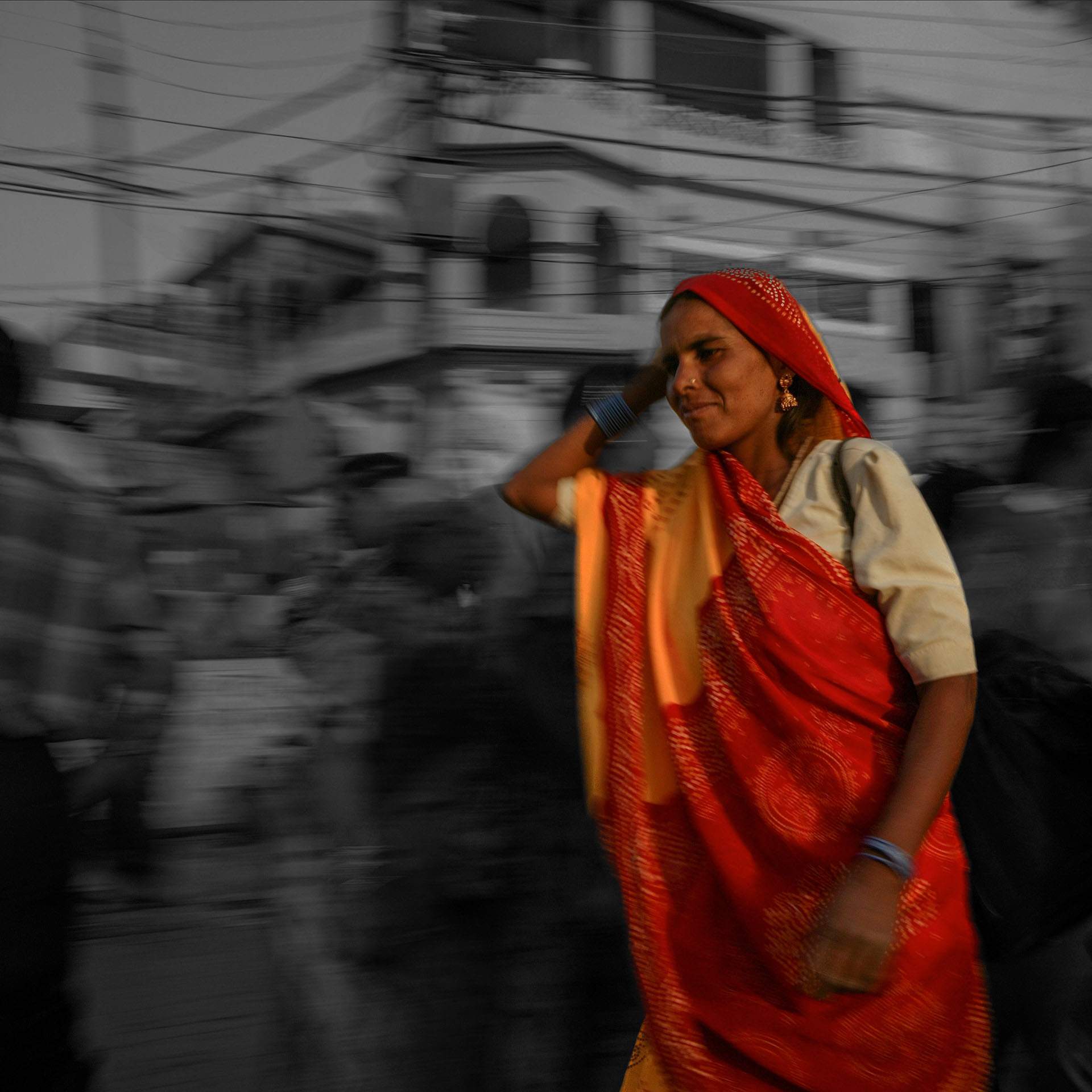
Monsoon Summer: An Item of Many Uses

by Miriam Snodell

Dupatta [doo-pah-tuh]: noun: A lightweight scarf worn by many Indian women to symbolize its translated meaning, virtue.

A Dupatta can be…
…worn for its intended use.
…a flimsy and relatively ineffective umbrella.
…a hand towel, for when the public bathroom has run out (or never had any in the first place).
…flung over one shoulder and treated as a superhero cape.
…pulled over the face entirely, in order to preserve your secret identity.
…a lousy jump rope.
…a teeny-tiny blanket.
…a cover for sneaking food into the movie theatre.
…flowy fairy wings.
…a babushka bonnet.
…a makeshift sling for a broken arm (though I have not tested this theory… yet).
…the catalyst for a three-legged race.
…helpful when Rapunzel’s hair is not quite as long as she needed it to be.
…eaten, when no other options remain.

A girl chases another in a game, trying not to lose her pink dupatta.

Miriam Snodell is a student at Union University, serving among South Asian peoples with her summer.

Monsoon Summer: Train Ride


By Kate Taylor

Chugchugchugchug. Chugchugchugchug. The repetitive sound of the wheels on the tracks drowns out everything except my own thoughts that rattle about in my head like a runaway rail-car.

Chugchugchugchug.

My right hand grasps a metal bar just inside the door and extends, allowing most of my body to hang out the door of the city train.

Chugchugchugchug.

The wind tosses my blonde hair around my face and tugs at the corners of my kurta, an Indian shirt that reaches to my mid-thigh. Chugchugchugchug. I watch the city landscape roll past and consider all the things I have already experienced in my time here in India.

Chugchugchugchug.

I have seen cows wandering the city streets.

I have tasted juicy mangoes of many shapes and colors.

Chugchugchugchug.

I have witnessed a baby girl snatched from the jaws of death. Her birth parents loved her enough to give her life by giving her away. They knew their family could not support another child, especially a girl child in a culture where boys are so preferred. Her adoptive parents saved her life from the tragedy of female infanticide. Because of the love of her two sets of parents and the love of Christ, stronger than death, she is a beautiful child with a bright future.

Chugchugchugchug.

I have heard the incessant honking of hundreds of cars, trucks, motorcycles and other two-, three- and four-wheeled vehicles too eager to wait their turn in traffic.

I have smelled incense burning from many altars to many Hindu gods.

Chugchugchugchug.

I have seen a woman without hope, hurting and broken. Despised because of her profession, this woman, who engages in prostitution to feed her children and support her daily needs, knows nothing of Christ who died for her.

I have wondered who will come, who besides Christ will give his life to save this woman?

Chugchugchugchug.

If He called, would I be willing?

“Here I am, Lord. Send me.”

Kate Taylor is a student at Union University, serving among South Asian peoples with her summer.

Among Asian fishermen, they seek to be ‘fishers of men’

Baptist Press, June 9, 2011: http://www.bpnews.net/bpnews.asp?id=35499

"God told us to be fishers of men," said Michael Cloer, pastor of Englewood Baptist Church in Rocky Mount, N.C. He stands beside a fishing net given to the church by a Koli fisherman in South Asia. The fisherman is now a follower of Jesus thanks to efforts by Cloer and the church to reach the Koli with the Gospel.

By Alan James

ROCKY MOUNT, N.C. (BP)–It hangs from the ceiling near the auditorium of Englewood Baptist Church like an overgrown spider web. It’s frayed and tattered in spots, with blue netting where it has been repaired multiple times through the years.

Pastor Michael Cloer runs his fingers along the fishing net, admiring the craftsmanship. As he inspects the net, he voices an impromptu object lesson.

“You look at the individual pieces and they don’t look like much, but together they are strong. … It’s a great picture of the church,” said Cloer, who received the net from a fisherman in South Asia when Englewood Baptist Church in Rocky Mount, N.C., took its first overseas missions trip to reach the Koli people for Christ.

That Koli fisherman is now a follower of Jesus.

A couple of months after the initial mission trip in February 2011, a second Englewood team returned to the same spot where Cloer had met the fisherman. By the end of 2011, the church will have sent four teams to engage the Koli people with the Good News.

At last year’s annual meeting of the Southern Baptist Convention in Orlando, Cloer said he became convicted that the congregation had not done enough to help reach people groups like the Koli — those unreached with less than a 2 percent evangelical presence and unengaged with no church-planting strategy among them.

“The Spirit of God just spoke to my heart and said, ‘What are we doing about unreached people?’” Cloer said.

Koli fishermen prepare their boats along the coast of South Asia. For centuries the Koli have been unengaged by any known Southern Baptist work, and less than a half percent of them are evangelical.

“We had been praying for them, just as a whole, but that’s as far as we were going. I came back and … began to pray, ‘God, where do you want us to go?’”

The church soon was committed to ministering to the Koli people.

Amidst a backdrop of modern conveniences and technological advances, the Koli people — with their colorful boats and waving flags — represent an old way of life committed to hard work, tradition and idol worship. Fishermen struggle to make a living in polluted waters in a time when modern life seems to have passed them by.

Most of the younger Koli generations hunt for new opportunities to escape the old way of life, while clinging to the worship of more than 300,000 gods. Of the 283,000-plus Koli people whom Englewood is engaging, fewer than half of 1 percent are evangelical.

“We saw a people group who were mainly fishermen, and the Lord immediately struck in my heart,” Cloer said. “God told us to be fishers of men … fishers of men among the fishermen.”

In the summer of 2010, the International Mission Board challenged Southern Baptists to adopt 6,426 unreached people groups based on that year’s research. At this year’s SBC annual meeting, IMB President Tom Elliff plans to narrow that focus to the approximately 3,800 unengaged, unreached people groups. Englewood Baptist Church’s partnership also will be featured at this year’s SBC meeting.

The Koli are now engaged with a church-planting strategy — and the work has just begun.

Church members venturing among the Koli in South Asia won’t have to look far to find challenges. On the streets they’ll find a variety of idols — ones surrounded in fresh flowers on cab dashboards or those swinging from the rearview mirror. Some will be displayed on posters along shop walls and encased in concrete shrines. In some homes they’ll find a cross, a statue or even a picture of Jesus, but locals view these as mere additions to their idol worship.

“To the Koli, Jesus is just another god,” said Claude*, an Englewood member the church is supporting to lead follow-up work among the Koli. Claude and his wife Lynne* plan to live in South Asia until the end of 2011.

“These people who live in these Koli villages along the coast are in total spiritual darkness,” Claude said.

But there has been some progress.

Francois Farge (right) strikes up a conversation with a man in a Koli village, while looking for a chance to share his faith. He learns this man left his people's fishing heritage to become a fitness trainer. It's a similar path many young Koli men take to avoid the economic challenges and tough work conditions many Koli fishermen face daily.

Since the Englewood team first set foot in the Koli villages, nearly 20 people have made a profession of faith in Jesus Christ.

“We had men and women pray out loud in front of other people: ‘I want Jesus Christ to be my Lord and Savior; I renounce all other gods but Jesus,’” Cloer recounted.

“We’d go back the next day, that individual had thrown out all of their idols into the street.”

The response has been an encouragement, but it also has served as a reminder of the follow-up work the church still has to do.

During the first trip, one Koli fisherman made a profession of faith. He agreed to have a Bible study at his home. But when Claude and a team returned a couple months later, the fisherman had changed his mind. He told the team another villager had attacked his wife for her faith and she had been prevented from using the well.

It’s slow work, said Kaleb*, an IMB representative among the people of South Asia.

“This [people group] has existed for thousands of years, but Satan has had a hold on [them],” Kaleb said. “When we go into these areas and make these big pushes just to get the Gospel out, we see Satan’s attack.”

The level of commitment needed to make a dent among people groups like the Koli is high, Kaleb said.

“I know lots of people back home who say they want to reach the nations,” he said, “but they’re not praying for the nations. They’re not going to the nations. They’re not sending others to the nations.

“Until we become doers of the Word of God and take this message to the nations, then nothing is going to change.”

Kaleb admits being pleasantly surprised when he first spoke to Cloer about Englewood Baptist Church working among the Koli. Cloer asked Kaleb how many teams he could handle and what it would take to get the job done.

“When I heard that, I realized they are in it,” Kaleb said. “Their hearts were committed. Knowing that churches like Englewood are out there … makes me feel like I’m not out here alone.”

‘WHATEVER IT TAKES’

In the coming months Cloer hopes to mentor fellow pastors in the U.S. in how to begin work among other unengaged, unreached people groups.

Though Englewood is larger than the average church, Cloer knows his congregation — and most other churches — can’t do it alone.

“I was led by the Lord, ‘Why don’t you ask other pastors to join you in this?” he said.

“We hear it from the national platform … but it’s another thing for a brother to look you face to face and say, ‘Brother, why don’t you get involved?’”

Cloer said after his time on earth is done, he hopes he will have helped reach 1 percent of those people groups unreached with the Gospel.

Just like that old net hanging from the church ceiling, together Southern Baptists are stronger than they are separate, Cloer contends.

“I believe there will be someone from every people group standing around the throne of Jesus,” he said.

“To think that we could have [that] opportunity … it’s going to be worth it all. It’s going to be worth whatever it takes.”

–30–

*Names changed. Alan James is a senior writer for the International Mission Board. Watch a video featuring Englewood at http://vimeo.com/24848768. It also will be shown during this year’s SBC annual meeting in Phoenix June 14-15. Used by permission. www.bpnews.net

Week of July 31, 2011

July 31 : Ramazan – Fast and Pray! From Luke 8:50: “Jesus said to Jairus, ‘Don’t be afraid. Just believe. She will be healed.’” Pray for the believers in Jesus not to be afraid, but to have faith and believe in the One who heals hearts. Pray that they will shine His light and share His love with everyone around them, no matter what their people group or religious group is. Jesus can change lives! Intercede for followers of Jesus not to doubt this. At sundown, July 31, Ramzan (or Ramadan) begins. It lasts one month, ending August 31. Ramzan is the fasting period for Muslims around the world. Muslims are generally more sensitive to spiritual matters during that time. Pray that the Lord Jesus will heal the hearts of those who are seeking and sensitive to spiritual matters, as they place their faith in Him. Ask for those who have a personal relationship with Jesus to be sensitive and obedient to the Holy Spirit in guiding them to share the story of Jesus with others around them.

August 1 : Mappila – Who are they? In the seventh century, Arab traders who sailed to the Indian state of Kerala to trade decided to stay and make Kerala their new home. There they married, adopted the language and culture, and began to multiply. At this time, Islam was a fairly new religion, which had begun around the year 610 with a man named Muhammad, who was said to have received revelations from God to restore true worship. Although this religion was new, it was strong and the Arab traders were wholly devoted. As the families of the Arab traders grew, so did the spread of Islam in Kerala. Today, the largest Islamic people group in Kerala are the Mappila, who number more than 8.2 million. “Please pray for Indian Christians who live among the Mappila. They are fearful and are not sharing the Good News with them. Pray for revival among the believers that will result in witnessing to the Mappila.” “Lord, may we also experience revival and not be fearful to join in praying, giving and going to the Mappila of Kerala.”

August 2 : Bengalis in Saudi. There are an estimated 1.5 million Bengali Muslims in Saudi Arabia. Typically these male migrant workers from Bangladesh are on a two- to four-year contract. They are treated poorly and have to work long hours six days a week, doing various types of blue-collar jobs: construction, assembly work, street cleaning, driving or janitorial work. Give thanks to the Lord that there are a few Muslim-background believers (MBBs) among the workers. Pray for continued boldness for the MBBs who are seeking to share the Good News among their Bengali friends. Pray that many Bengali Muslims will come to know Jesus while working in Saudi Arabia and will carry the Good News back to their extended families in their home country. http://prayerthreads.imb.org

August 3 : Gypsies of Pakistan. Recently workers in Pakistan were involved in helping with community development among the Gypsies of Pakistan. Gypsies in Pakistan are sometimes nomadic, although they normally live in tent villages on the outskirts of various cities. They speak their own languages and often have their own culture. They beg, work as laborers for minimal pay, and do whatever they can to earn a living. Very few people are working to alleviate their suffering. Several national believers from Gypsy backgrounds are working among these communities, teaching basic skills such as sowing, literacy, craft-making, etc., as well as sharing the Gospel with these usually Muslim people. Several have come to Christ. Workers have recently teamed up with these nationals in order to build wells and latrines in one community where otherwise there were few facilities. Seed was sown, and follow-up is being conducted. Please pray for these “least of the least,” asking that they will come to know Him who for their sakes became poor, so that they through His poverty might become rich (see 2 Corinthians 8:9).

August 4 : Small Home; Big Heart. P is a former Bihari Muslim who lives with his wife and three daughters in a small, rented house that has no bathroom. The family must use a community toilet. Several years ago, you were asked to pray that P would find a more suitable place to rent. At that time, P wrote: “Hindus deny giving their house to us due to my Muslim name, and Muslims deny because I am a blasphemer in their eyes.” They have since remained in the same house; but as their daughters grow older, it has become more dangerous for them to use the community bathroom. Lack of consistent water and electricity is another problem. P now plans to withdraw his pension funds and take out loans to purchase a small plot. Please pray that the Lord will give him wisdom and direction. Pray that wherever the Lord leads them, their home will be a place of ministry that offers Good News to Muslims. BihariBride@pobox.com

August 5 : Asking for Growth. “The year is half-way finished, and it seems like there has not been a lot of progress in the work. Between language study and national believers moving to other areas, it seems like we are starting from scratch in many ways. Please pray for a fresh vision for the work. Ask God to open doors for the Gospel, and to call out laborers for the harvest, specifically national partners. Pray that local churches will begin asking to be taught how to reach Muslims around them. Pray that existing Muslim-background believers will have a burden for reaching their own people and that they will get the tools needed to start reproducing house churches. Ask God to give Muslims throughout the state dreams and visions that confirm salvation through Jesus. Ask Him to send believers to disciple those who want to follow Jesus. Pray that during the last five months of this year, there will be much fruit in the ministry among the Muslims of Karnataka.”

August 6 : Father At Work. Over the last month or so, faithful workers have traveled over the Deccan Plateau of southern India. They have spent time meeting recent believers and sharing the Good News among the Deccani Muslims. Thank the Lord for the growth and maturity coming to the recent believers. Some are actively reading and obeying God’s Word. Some Konkani Shaikh Muslims have responded to the Gospel, as have some Marathi-speaking Shaikh Muslims. In other areas, Urdu-speaking Shaikh Muslims have been responding. It has been exciting to see this taking place, as these people groups have been classified as Unengaged Unreached People Groups (UUPGs). God is at work among the Deccani Muslims in answer to your prayers. Praise the Lord for the powerfulness of His Word! 

Monsoon Summer: Ode to India

by Miriam Snodell

Sometimes when walking down the street,
A strange rank odor my nose does meet.
Feces, smog, and trash, to spare,
The aroma of India in the air.

Pungent and rich, the taste fills my mouth;
I swallow the food, and it starts to head south.
A slow burn caresses the back of my throat,
On fire without water, I’ve been pleasantly smote.

Horns honk and bellow and throw out a tune;
From dusk til dawn, and midnight til noon.
Though I really don’t mind, things sometimes get hairy;
I occasionally want to ask — “Is that absolutely necessary?”

My angry hair whipping all over my face,
The rickshaw accelerates in that everlasting race
I wonder if the engine should be shaking like this;
These adrenaline-producing rides are something I’ll miss.

A million faces fly past my eyes,
A million hungry looks, a million wordless cries.
They don’t have the hope, they need something more.
Colorful clothes disguise a hopeless and hurting core.

A feeling that came from my deep down inside,
An emotion that be described as both deep and wide;
I fell in love with this country, right at trip’s start,
It’s a foregone conclusion: So much for guarding my heart.

Miriam Snodell is a student at Union University, serving among South Asian peoples with her summer.

Monsoon Summer: Bon Appetit!

By Kate Taylor

I cross the street and wade through a crowd of people and parked motor scooters into the entrance of a popular-looking Indian restaurant. An air-conditioned section in the back is cool and quiet. At the table, I scan the menu full of indecipherable combinations of consonants and vowels like aloo chaat and palak paneer. Our Indian friend rattles off orders for all of us and Miriam and I sip on custard-like drinks that taste of caramel and almond.

The food arrives and we swirl the sauce and rice on the plates together with our fingers, devouring spicy red and yellow foods as quickly as our hands can carry it to our mouths. Delicious!

The restaurant manager comes over and, in accented English, asks us about our meal. Apparently satisfied with our enthusiastic replies, he turns away and throws back a “Bon appétit!” over his shoulder.

India is constantly surprising me. Just when I think I have fallen into the rhythm of things, a misplaced beat, like a French phrase, knocks me off like an amateur drummer.

I am easily thrown off by the cows that wander the city streets and the indiscernible head bobbles that could mean yes, no or anything in between. When I try to bobble my head, it comes across more like a squirming two-year-old or the awkward first steps of an African tribal dance. I feel unsure of myself as I traverse the landscape of a culture so removed from anything I have experienced before.

Traveling abroad can be trying, exhausting and uncomfortable but our God is God over all cultures, languages and peoples and it is His desire that every man should hear the Good News. His Word crosses the borders between countries and the barriers of peoples’ hearts because His disciples sacrifice their lives to take it there.

Pray for the lost people of South Asia who are living life without hope in a Living God. What are you willing to sacrifice? How are you going to live your life in order to see all peoples come to Christ?

While India can be exciting, jarring and more than a little confusing at times, I am grateful for the experiences I am having here and for the ways I see God at work.

Kate Taylor is a student at Union University, serving among South Asian peoples with her summer.

Monsoon Summer: Two Indias

The Taj Mahal, seen here through an open gateway, is known for its white marble dome.

By Kate Taylor

Through the dingy glass of my backseat car window, I watch two faces of India pass by. Across the River Yamuna, the Taj Mahal stands white and shining in the sun. Even from a distance, the monument looks like the billions of dollars it’s worth. The glint of its white marble dome leaves me awe-struck and breathless.

This face of India is a land of wealth. In this India, people know prosperity. They wear brightly colored clothes and fine gold jewelry. They have servants for their air-conditioned homes and drivers on standby to take them shopping in their shiny SUVs.

Yet on the bank of the river opposite the marble wonder, I see a woman in a dirty sari sitting atop a mountain of trash. Two boys play shoeless in the clay mud while a group of men laze alongside the road with no work to do, even in the middle of the day.

These world-weary people, living next door to one of the greatest and most valuable of the world’s marvels, cannot afford the $15 entrance fee to see it. They live in an India of poverty, dirt and slums; an India familiar with hunger and desperation.

India, like many other countries with a growing divide between rich and poor, has two faces. Since Eve took her first bite of forbidden fruit, inequality and injustice, in one form or another, have become permanent features of our broken world.

I cannot tell you why life is easy for some and hard for others, why some people are at a disadvantage before they are even born and others will never have to worry about where their next meal comes from. But I can tell you that in a country where less than two percent know Christ, millions of people from both faces of India need an introduction to the God of hope.

Kate Taylor is a student at Union University, serving among South Asian peoples with her summer. You can read more about her adventures with Miriam Snodell at http://southasianpeoples.imb.org/blogs/.

Monsoon Summer: “Honk Horn Please!”

By Miriam Snodell

In some cultures, the lines on the road are significant. In those same cultures, the government posts speed limit signs. It is culturally offensive to overuse one’s horn.

In India, it is not uncommon to see a large truck barreling down the center line of a main road (with a heavy load riding uncovered and precarious in the back), sporting a “Honk Horn Please!” sign painted across the rear bumper.

And don’t worry, everybody will respect the sign. In fact, there is so much respect for the sign, that a road without honking is probably a road without traffic.

Rickshaws are an easy form of transportation in India

One of the frequent users of the road is an interesting little auto contraption called the rickshaw. I am confused as to why this ghetto motorized Indian three-wheeled vehicle is referred to as a two-wheeled Chinese human-powered carriage, but hey, who am I to judge?

An Indian rickshaw is a sort of cheap taxi, with room to comfortably fit three in the back (although, this is not to say that more cannot be forced in). The wonderful thing about this tiny taxi is that, although it is larger than the average two-wheeler, it is small enough to dart dangerously in-between implied lanes and shoot across several lanes of busy intersection traffic.

To call the average Indian’s style of driving “opportunistic,” would be erring on the side of politeness. And to say that smaller vehicles drive more safely because of their likelihood to lose in an accident — well, that would be false too.

Like eating live bugs, or bathing naked in a river with 200 of your closest native friends, being a passenger in a rickshaw is a cultural experience.

Miriam Snodell is a student at Union University, serving among South Asian peoples with her summer.

Monsoon Summer: Caught in the Rain

By Miriam Snodell

Nine girls unload out of a tiny taxi-van, clown-car style. They duck into the pouring rain, laughing at the memory of their Indian driver playing Justin Beiber. A fellow native passenger with the foresight to pull out his video phone has a golden upload ready for Indian YouTube.

Memories of the Biebs and “Baby” quickly get washed away in the torrential rainfall, as several city blocks separate the girls from their final destination.

I am one of these girls, and I am laughing just as hard as any of them as we hold hands and run across the street, water from puddles splashing up as high as our shirts. Our shoes squelch ominously underfoot, and I am keenly aware of the complete lack of traction on my worn out flip-flops.

Indians take time to peer curiously through car windows and stop dead on the sidewalk, clueless as to why a pack of dripping girls would be doing what they were doing. Apparently, it is worth the extra dampness to see such an unusual sight.

I have hopes that at least one of these Indian bystanders witnessed me running headlong into a sign, cartoon-style, because none of my friends did. I would like to blame the rain for obscuring my vision, but I’m pretty sure I have just been blessed with a complete lack of spatial awareness.

Less than five minutes later, we encounter a short flight of slippery, downward stairs. Heroically, I take the steps solo, not wanting to hold somebody’s hand and bring them down with me.

In case you were wondering, sitting at the bottom of a flight of stairs is just as humiliating as you think it is. But still, humorous.

Nine girls stand dripping in the lobby of a hotel, not quite so breathless from running that they cannot continue laughing. “Dry fabric” is an unknown concept, and “dignity” is a thought long abandoned. The rainy season has come. Welcome to monsoon summer.

Miriam Snodell is a student at Union University, serving among South Asian peoples with her summer.

In Asia, couple is at peace among unreached

"It's like home," said Lynne, a member of Englewood Baptist Church in Rocky Mount, N.C., referring to a South Asian city of 12 million where she and her husband, Claude have been living since April 2011.

Baptist Press, June 9, 2011: http://www.bpnews.net/BPnews.asp?ID=35501

By Alan James

SOUTH ASIA (BP)–Taped to the inside of their apartment front door is a list of essentials — “phone, water, keys, money, copy of passport” — that a North Carolina couple doesn’t want to forget when leaving venturing into the streets of a South Asian city of 12 million people.

Claude and Lynne*, members of Englewood Baptist Church in Rocky Mount, have been living in South Asia since April 2011. One item that’s not on that list but is crucial to their ministry among the Koli people is prayer.

Answered prayer is why they are there.

The couple plan to live in the South Asian city for at least 10 months to help Englewood with follow-up among the Koli — an unreached people group that did not have a church-planting strategy among them until recent months. Englewood began a partnership among this people after the 2010 Southern Baptist Convention annual meeting in Orlando.

Claude first felt the call to live among the Koli after his pastor, Michael Cloer, returned from the SBC with a conviction that Englewood should do more to spread the Gospel among those who haven’t heard about Jesus.

“I wondered if that could be us,” Claude said of Cloer’s passion. “I didn’t know if God was in it or not. I just kind of thought about it, prayed about it. It looked like a tremendous opportunity.”

At the time, Claude and Lynne — like many Americans — had issues with debt, bills and thoughts of missing their children and new grandchildren. Nevertheless, the couple became more compelled to learn about this new opportunity.

Then their world was rocked when Lynne was injured in a car accident.

A truck struck her vehicle as she was driving through an intersection, leaving her unconscious with two fractured bones in her back, a cracked rib and internal bleeding.

Then doctors discovered something else.

“The internal bleeding was actually [caused by] a tumor on my right kidney,” Lynne recounted.

“It was fairly large, so we had to process that.”

At that moment, plans of going to share Jesus among the Koli people no longer were “on the radar.”

Yet, Lynne said, “God was with us. We sensed His presence carrying us through this, [but] we were not thinking about the Koli people at this time.”

“This is God’s answer — we’re not going to [South Asia],” Claude added. “The focus of our life was my wife … and her health. I kind of just let it go.”

And then as quickly as cancer entered their life, it was gone. Doctors removed the tumor before it could spread to other organs.

“God was so good,” Lynne said. “He had such a perfect plan. That accident was a way for the doctors to find the tumor. Now I’m cancer free.”

Still, even though the cancer was gone, obstacles remained that kept them from being sure God was still calling them. “Before Lynne’s accident we were thinking about our children, finances, bills, debt and things that would keep us from going,” Claude said.

One by one, however, each barrier began to fall as the couple prayed and let go of their fear.

“In Mark 11, Jesus said, ‘I say to you whoever says to this mountain be removed and cast into the sea … but believes those things he says will be done,’” Claude said.

“You start understanding that if God’s in us going to South Asia, if it’s His will, He can topple mountains. My future and our future … we just surrendered that.”

Claude walks alongside a local translator to follow up with Koli people who have expressed an interest in Jesus Christ.

In February 2011, the couple went with a team from Englewood Baptist Church on a week-long vision trip to South Asia, with the plan to return to South Asia weeks later and stay for 10 months. On their first trip with Englewood, the first three days were a “mountaintop” experience, as Claude described it.

“We were with the Koli, people were coming to Christ, we were being let into homes,” he said. “Wow … this is so fun.”

“We were welcomed,” Lynne added. “We were treated with such respect and honor no matter what home we went in. We were given the best food. Whatever they had, they gave it to us. It was just so refreshing … the love of the people was just overwhelming.”

Then reality hit.

“We crashed after the third day,” Claude said. “I believe it was spiritual warfare. I believe the enemy came against us.”

“It’s a very intimidating city, overwhelming,” Lynne said. “There were things that I saw and smelled. I couldn’t process it and deal with it. It was just so much in your face.”

The peace of God that Lynne once felt vanished as she struggled more and more with doubt. Even simple tasks like walking along the city streets and navigating traffic were a challenge.

“What are you doing here?” she thought. “You don’t speak [the language]. You can’t even cross a street.”

Claude also struggled with discouragement. “The adversary really came against us,” he said. “He’s been controlling these people for thousands of years. This is an unengaged, unreached people group. There’s no light [of Christ] among them.

“So when two people ‘bebop’ over here from the States, thinking they’re gonna go into [Satan's] territory that he’s had for thousands of years and rescue people with the Gospel, he came against us.”

Both now say their “low point” was a combination of fatigue, spiritual warfare, culture shock and the stress of moving from family.

Lynne credits the prayers of friends back in the States with helping her cope with the challenges. One friend later told her she specifically prayed that Lynne would feel at home while she was away.

Those prayers made all the difference, Lynne said.

“I’ve totally adjusted,” she said. “Even though I hear horns … it’s noisy and loud, I can sleep through the night. It’s like home.”

–30–

*Names changed. Alan James is a senior writer for the International Mission Board. Used by permission. www.bpnews.net