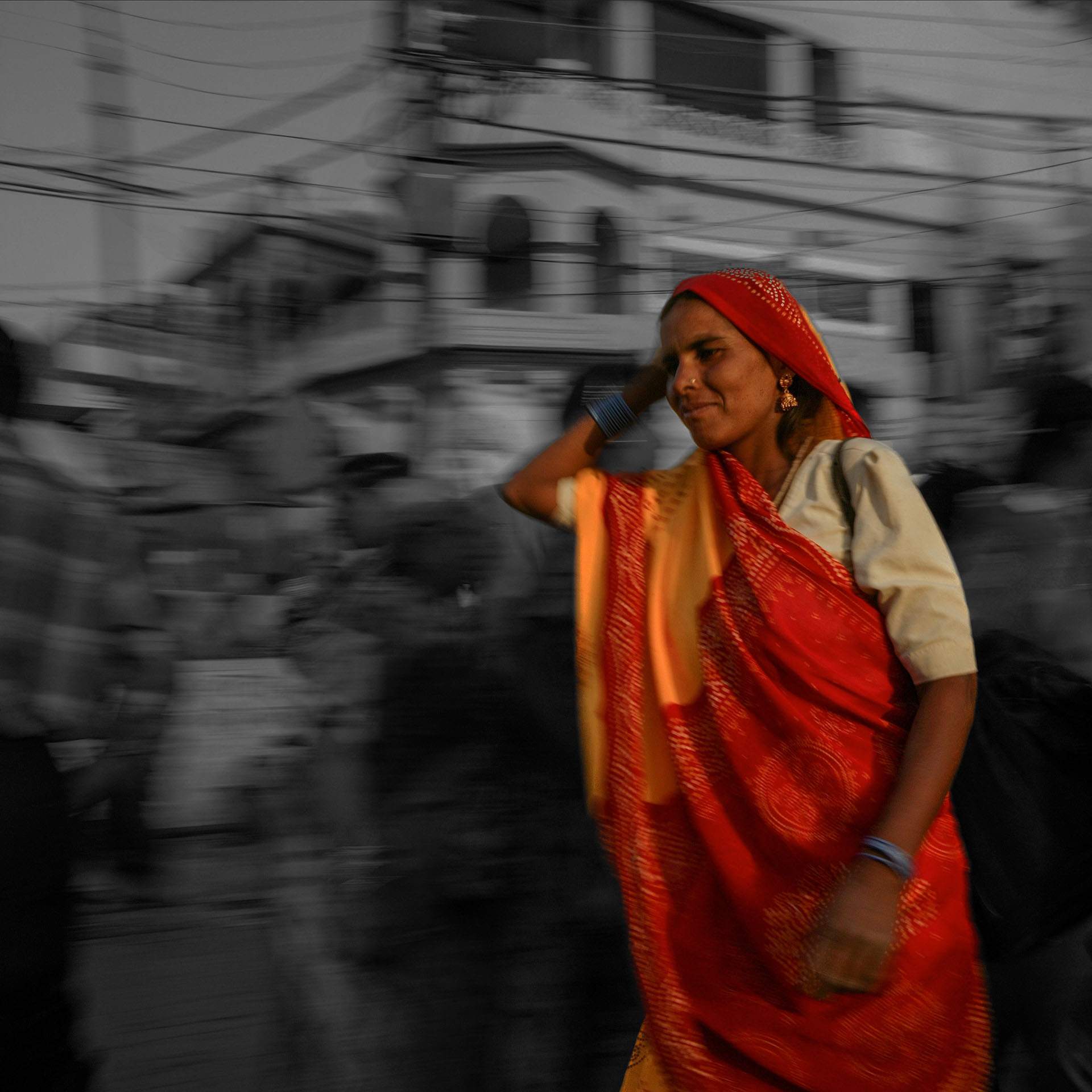
FIRST PERSON: God works through one woman sharing Bible stories with her friend

By Jacey Curran*

INDIA — My friend Saachi* is the only believer in her family, but she’s excited about Jesus. Over the past month, a couple of my friends and I have visited Saachi’s family several times. Our visits have given Saachi a freedom to share with her family that she’s never had before.

Even though no one in Saachi’s family believes in Jesus, Saachi’s grandmother, Dahdi,* is interested, and we’ve been able to share several Bible stories, like the creation story. The first time we visited Dahdi, we prayed that her blood sugar would come down so that she could have eye surgery…and it did! Later, Dahdi told us, “If I can have my eye surgery on Thursday, then I will believe in Jesus.” Even though she didn’t have her surgery on Thursday, it was less than two weeks later. Now, her eyes are much better.

Exciting things keep happening in Saachi’s household.

One week we were able to share the creation story with Dahdi, and Saachi’s sister, aunt, and cousin came to listen too. The next week we shared the rest of the story about Jesus and the Father’s plan of redemption.

One day an elderly lady and her middle-aged daughter came to our meeting at Saachi’s house. The daughter’s purse, containing a lot of money and many important documents, had just been stolen. They wanted us to pray that the documents would be returned. Before we prayed, we told them about the Father’s promise to Abraham. After we finished the story, Dahdi told the women how Jesus had healed her eyes.

The next week, the women came back and told us that someone had brought the purse to their home and the documents had been returned! The women were eager to hear more stories about Jesus. That week we prayed that the daughter would soon find a job. The following week, the elderly woman came without her daughter, telling us that her daughter had found a job at a pharmacy.

Saachi’s grandmother and other female family members are still not willing to follow only Jesus, even after seeing many prayers answered, but they are very open to hearing stories and talking about Jesus. Now, even Saachi’s 17-year-old brother comes every time we visit and listens to the story and has started singing songs with us. Just weeks ago, this would never have happened. One time when he was outside with his friends, he even beat on the window of Saachi’s house, telling us to not sing so loudly. Things are changing.

In the midst of God moving in this family, we just got some discouraging news. Many of the neighbors around Saachi’s family started pressuring her family and her grandfather told Saachi that we weren’t allowed to come sing songs and pray in their house anymore. Her grandfather said that we could still come and drink chai and talk, but we couldn’t sing or pray. We are hoping that we will still have chances to share stories and truth with Saachi’s family in a more casual way.

Please pray that:
• The eyes of Saachi’s family and her neighbors would be opened to the Truth and put their complete trust in Jesus.
• Dahdi would see that Jesus is not only the one who healed her eyes but also the One who died for her.
• Saachi would not be discouraged by her grandfather’s words but would continue to trust the Father and His plan.

—30—
*Name changed.

Jacey Curran is a representative with International Mission Board, serving in South Asia.

Week of July 3, 2011

July 3 : Needing Freedom in Christ. Located in the plains of eastern India are the Mal people, a people group with a rich tradition of Buddhism. Sacred rites and festivals have religious and economic significance. Among the Mal, women hold a very low social status. They have no decision-making powers despite their contribution to the family income. Intercede on behalf of Mal women who work hard in the fields but gain little respect in their homes or communities. Ask that their eyes will be opened to see Jesus, the One who raised the stooped woman from His feet and caused her to walk in newness of life. http://prayerthreads.imb.org

July 4 : World’s Largest Democracy. India, with more than 1.1 billion people, is known as the world’s largest democracy, and it is believed that there is religious freedom in that country. However, Christians  are persecuted daily and falsely accused of forcefully trying to convert others to Christianity. In light of recent world events, please pray that Christians throughout India will continue to be bold to share their faith. Praise the Lord for those who, in the midst of beatings, humiliation, and sometimes torture, remain faithful to live their lives for Jesus.

July 5 : Beautiful Feet. Please pray for a group of American university students who are giving their summer to reach out to Bangladeshi students. These Christian youth have a God-given passion to see the lost around them come to know their Savior and Lord. They will learn to dress differently, speak some of the local language, and adapt appropriate cultural norms in order to be able to share best with them about Christ. Pray that God will open up numerous doors for them to meet Bengali students and gain access to their universities for the glory of God. Pray that many young people will be filled with a God-given desire to hear the American students’ stories and question their reason for coming to spend their summer with them. Pray that God will use these beautiful hands and feet to guide many others lost in their sins to the light of Christ. The student volunteers will also spend time with some of the Christian youth. They are a small minority in Bangladesh and don’t seem to live their faith. Pray that God will spark new passion in their lives through the testimony and witness of those who come to share His love. Pray for a revival among this next generation of the church.

July 6 : South Asians Near You. You have probably met them at convenience stores or budget motels. Yes, more than 37 million South Asians now live outside their “home countries” (India, Pakistan, Bangladesh, Sri Lanka, Maldives, Nepal and Bhutan). They might be recent immigrants, struggling to learn the language and navigate the government system of their host country, or they might be descendents of immigrants who occasionally visit the home of their ancestors. Four major faiths are represented – Islam, Hinduism, Buddhism and Sikhism – and there are some Jesus-followers! But what if there were South Asian congregations that started new South Asian congregations? Maybe millions could be reached for Christ where they now live: Africa, Southeast Asia, Europe and North America. In order for there to be rapid reproduction of believers and churches throughout the South Asian Diaspora, more national partners (South Asian and local) need to be identified and trained. Please pray that such partners will be found and trained. Please ask the Father to place a burden on the hearts of His people for reaching South Asian immigrants who live near them.

July 7 : Overcoming Fear. Give thanks to God that in answer to your prayers, the Muslim-background believers who formerly were “lying low” due to community pressure have received boldness from the Lord! They have been actively showing the “JESUS” film in two public areas. Many people have responded – some with tears, some with apathy, and some with anger. Several D Muslims have asked for Bibles and have expressed a desire to know more. A local Muslim shopkeeper even let them use his electricity to show the film. Pray that more Muslims will be overcome by the truth of the Gospel of Jesus Christ and respond in faith.

July 8 : Kalal – Key to Gospel. “Last month we asked you to pray for the Kalal Muslims, and this month we ask you to pray for the Kalal Hindus. We believe that this group is the largest unengaged unreached people group in Karnataka, India. With a background in Islam, this group holds a unique place in the community. Although this group no longer holds to Muslim traditions like circumcision, their background gives them a special relationship with Muslims. This relationship is evident in many areas. The sharing of food is unique in India. Most communities will not accept food from those whom they see as beneath them. Most communities in Karnataka see the Kalal as beneath them and will not accept food from them, but the Muslim communities of Karnataka will accept food from only this Hindu community. The Kalal are traditionally sellers of meat (not beef). They work closely with Muslims in this occupation. The Muslims slaughter meat, and the Kalal clean and sell the meat. Because of this community’s unique position in society, we see them as a special key to the Gospel flowing between the Muslim and Hindu communities. Pray that the Kalal will embrace the truth of the Gospel and that we will see the Gospel flow between Hindus and Muslims as never before!” http://prayerthreads.imb.org

July 9 : Kashmiri Bible Available. “All Scripture is inspired by God and is profitable for teaching, for rebuking, for training in righteousness, so that the man of God may be complete, equipped for every good work” (2 Timothy 3:16-17). The first modern translation of the Bible in the Kashmiri language was recently printed and is now being distributed among the handful of Kashmiri believers participating in house churches. Pray that the Father will raise up teachers of the Word, that any lies spoken against the Word in local places of worship will be dispelled, and that there will be a great desire in people to receive God’s Word in their heart language. Also pray that along with Bible distribution, non-literate men and women will participate in a literacy project started by workers here in order to teach people to read the Kashmiri Bible for themselves.

Ban the Bible, Pakistani politician says

Baptist Press, June 6, 2011: http://www.bpnews.net/BPnews.asp?ID=35466

By Nina Shea

]WASHINGTON (BP)–Adam and Eve sans fig leaves, Lot getting drunk, Jesus stopping a stoning -– this is all too much for Muslims represented in Pakistan’s parliament by the Jamiat Ulema-e-Islam party.

In their view, Bible stories such as these amount to “pornographic” slurs against the biblical figures whom they claim as their holy prophets. They are now demanding that the country ban the Bible because of such “blasphemy” and exact a “punishment.”

The Jamiat Ulema-e-Islam party’s leader, Maulana Abdul Rauf Farooqi, at a press conference on May 30 in Lahore, informally petitioned the Supreme Court, complaining that the Bible includes stories about some of the biblical prophets that include “a variety of moral crimes, which undermine the sanctity of the holy figures.”

A newspaper reports: “Farooqi cited a number of [supposedly pornographic] scriptures from the Bible, saying such ‘insertions’ strongly offend the Muslims, who hold all prophets and holy books in high esteem, as part of religious belief and never even think of committing any blasphemy against them.”

The verses in question are: Genesis 19:33–36; 29: 23, 32–35; 38:18; Exodus 32:2–6; 1 Kings 13:2–29; 2 Samuel 11:2–27, 13:1–22; Matthew 1:13, 16:23, 26:14–47.

There seems no limit to what could be considered an offense against Islam under Pakistan’s notorious blasphemy laws.

Christians and other religious minorities have been disproportionately prosecuted under Pakistan’s blasphemy laws, which can carry the death penalty. Local Christians, estimated at 3 million, fear the call for a Bible ban is a sign of a trend of deepening persecution against them.

As in many of Pakistan’s blasphemy cases, political motives may be at the root of the complaint. Farooqi cited Florida pastor Terry Jones and said the party would not burn the Bible, as Jones has done with the Quran, but would formally lodge a petition if the high court failed to act on its own to ban the Bible.

There would not be a clash between the two religions, Farooqi ominously promised, as long as the courts are functioning. Pakistan’s Islamists also are agitated by the killing of al-Qaeda leader Osama bin Laden by American troops in that country.

The definition of blasphemy under Pakistan’s laws is vague and can include offenses that are committed “by any imputation, innuendo, or insinuation, directly or indirectly.” Blasphemy charges have been brought against Muslims as well — in one recent case, for tearing off a page of a wall calendar that had a koranic verse written on it, and in another, for throwing away the business card of a person named “Mohammad.”

Attempts to repeal Pakistan’s blasphemy laws have so far failed as extremists have become emboldened under them. Punjab’s governor, Salmaan Taseer, and federal minister for minorities Shahbaz Bhatti were murdered earlier this year for their opposition to the blasphemy laws.

Pakistan’s top leaders have long advocated a universal blasphemy law. Every year for over a decade, the nation introduced a resolution in the United Nations’ Human Rights Council and its predecessor body, calling for a worldwide ban against “defamation” of Islam. The resolution has routinely passed, but support decreased over time, and it was not introduced at the last session in March.

–30–

Nina Shea is director of the Hudson Institute’s Center for Religious Freedom and co-author with Paul Marshall of the forthcoming book “Silenced: How Apostasy and Blasphemy Codes Are Choking Freedom Worldwide” (Oxford University Press, 2011). Shea also is a member of the U.S. Commission on International Religious Freedom. Used by permission. www.bpnews.net.

Women reach women through henna and Bible stories

Once the part of the design that tells a story is finished, the person drawing goes back to add "filler" to the complicated design.

By Haeley Rivera

DELHI, India — In the United States, “henna” brings to mind beaches or fairs and the temporary tattoos that can be gotten at little booths set up along walkways but, in South Asia, women are using henna to reach out to other women with the Good News of the Gospel.

Henna covers women’s hands, and sometimes feet, in brownish-red intricate patterns for special occasions like weddings and holidays. When women get together, they will often draw simpler designs on each other, decorating each other’s palms and wrists.

Traditional henna does not tell stories. Adornment is the only purpose of the designs. Through the creativity, patience and interest of many Christian women in South Asia, traditional icons have begun to take on meanings that point to the love, grace, forgiveness and promises of God.

Many cross-cultural workers in South Asia spend a couple of hours each week doing henna parties. To prepare, the ladies learn a Bible story and the henna design that relates to that story. Some cross-cultural workers learn versions of the story in the local language, like Hindi. Others use translators.

In a male-dominated culture, henna is one of few things strictly for women. Henna groups provide a time for women to learn from the Bible. “Women aren’t usually in Bible study groups with men here. If they are, they certainly won’t say anything. Women need their own thing,” says Vanna Larcombe.*

Peace is the theme that binds together the Bible story set that accompanies the henna designs. “Women want [peace] in their lives and relationships. It’s what they are looking for,” says Kerry Corliss.*

After prayer, henna parties usually start with a time of sharing. Facilitators like Corliss and Larcombe ask the ladies if they drew the design on or told the previous story to any of their friends. This time gives women accountability to be sharing what they are learning about God through the Bible stories; it adds depth to the event because women are challenged each time to go out and share their faith, knowing they will be asked about their experiences the next time they meet.

Next, the meeting transitions into the new story. The leaders tell the new story two to three times before asking the group to act out the story as someone tells it. Then, they ask volunteers to retell the story. Each group member tells the story and is encouraged to help the others if needed. The goal is that each woman be able to retell the story on her own.

Once everyone has told the story, comprehension questions follow. Women are asked to share what they learned from the story and how the story relates to their own lives, for example.

Women in these groups especially love the stories that illustrate the peace that can be found in Jesus and His love demonstrated specifically to women. For instance, women really like the story from Mark 5:25-34 of the sick woman. “Jesus specifically wanted to find the woman and speak to her; he made it a point to find her in the crowd. He called her ‘daughter.’ I think, in South Asian culture, that it’s important for women to see their worth in the eyes of Christ.” says Larcombe.

A group member uses the henna to tell the story to a woman who came late and did not get to hear the story.

Other favorites include the creation story (where it says that God made woman because it was not good for man to be alone) and any of the henna designs that cover most the palm of the hand in the pattern. The more intricate and complicated the design, the more beautiful they think it is.

To keep everyone’s attention on the Bible story, the henna design is only revealed after the story has been told, retold, and the questions answered. After everyone has the design and understands which parts of the picture tell the story, then the henna cones come out. Henna cones are tubes that contain henna paste used to draw designs.

According to Corliss, there are two types of henna parties. Some reach out to share the Good News with people who do not know. Others bring believers together to fellowship and grow.

On the one hand, the outreach group is a bit “chaotic,” says Corliss. Although a few adult women attend the group meetings, the majority of the group is young girls and teens. “Many of these girls just come because they want the henna on their hands,” says Larcombe.

It took several meetings, but the group is beginning to expect the storying time and come prepared to hear a story from God’s Word before getting henna.

On the other hand, the study and fellowship group has a completely different feel. Corliss says that this group is mostly adult women who are used to sitting to listen and learn from the Bible. This group wants to hear the truths of the Bible.

Once the henna comes out, however, they are just like other Indian women. They eagerly await the beautiful designs to be drawn on their hands. Most of the ladies who attend this group use the henna designs on their own hands to retell the stories between henna parties but it is difficult to convince them to try drawing on others.

How can you pray for women in South Asia?
• Pray that these groups would continue to be a safe place for women to learn about the Father’s love for His daughters.
• Ask Him to stir a hunger for His love in those who do not know Jesus and a desire to share in those who do.
• Lift up the women leading these groups as they seek to use henna as a creative way to relate and reach out to women in South Asia and in other parts of the world.

—30—

*Name changed.

Haeley Rivera is a Hands On volunteer currently serving among South Asian peoples. Rivera recently graduated with a master’s degree before beginning her six-month term. For more information on short or long-term volunteer opportunities, go to http://southasianpeoples.imb.org/connect/. For more information about henna storytelling, go to www.southasianpeoples.imb/henna.

Week of June 26, 2011

June 26 : Summer for Jesus. This month, the summer workers whom God has sent will begin English workshops in three different areas of Kolkata. Plead for God to draw participants who are hungry to hear the Good News of Christ. Pray that the summer workers will be able to build relationships with those who come to the workshops and form groups to share Bible stories for the purpose of telling the participants about Jesus.

June 27 : New Testaments Needed. Give thanks to God for the increased demand for New Testaments among the Sindhi people. Please pray, as there will be another large printing of the Sindhi New Testament. Ask for God’s Word to make an impact and to bring spiritual fruit.

June 28 : LEAD students challenged. During this spring semester, LEAD students have studied the Book of Acts, personal evangelism, and church planting. Through these subjects, they have been taught that every believer has been commissioned to “go and make disciples,” and that every believer needs to be trained in how to do that. Making disciples goes beyond giving a testimony or preaching a sermon or introducing a person to Jesus. It also involves follow-up discipleship. Pray that these students will be faithful to use what they have been taught, train the flocks they have been given to “go and make disciples,” and plant churches that will multiply rapidly as the believers do what God has called each one of us to do.

June 29 : Reason to Celebrate! In April, you prayed that Hindus in South Asia celebrating the Hindu New Year would realize the value of each day, especially those spent not knowing Jesus as Lord and Savior. God did something amazing in response to your prayers! Three Hindu families met for Bible study during the New Year festivities! These families are continuing to meet and learn about Jesus and how He changes lives. Pray that these eight Hindus, meeting with one believer, will open their hearts to the Gospel, and that they will claim Jesus’ salvation for themselves, giving them a reason to celebrate every new day!

June 30 : Death of a Guru. More than likely, April 24 passed as an ordinary day for you. But for many Hindus in South Asia, indeed around the world, April 24 marked the death of Sathya Sai Baba, a highly revered spiritual leader. His death shocked many devout followers, for he had claimed to be divine. Many rumors swirled around Hindu communities that he would rise again after three days. They were sorely disappointed. His death leaves a gap in their faith. Please pray that Sai Baba’s followers will now seek the one true God “who was and who is and who is to come” (Revelations 4:8, NASB). Pray that they will have opportunities to hear the Gospel, and that they will respond to God’s love and to His only provision for salvation: the life, burial, and resurrection of Jesus Christ.

June 31 : Kalwar Need Jesus. The Kalwar are an unengaged unreached people group. The Kalwar people have been known traditionally for the manufacture, distilling and selling of liquor. Today they often also own and run provision stores or serve as businessmen. Women are responsible for managing the household. By and large, the Kalwar do not own land, though literacy rates are fairly high. They worship Hindu gods and goddesses, and perhaps show more reverence to the goddess Lakshmi (goddess of wealth and prosperity) and the god Shiva (the “destroyer”). They observe animal sacrifices and pilgrimages. Please pray that the Kalwar people will come to know Jesus as the Ultimate Sacrifice. http://prayerthreads.imb.org

July 1 : Silk and Mangoes. Rajshahi District rests at Bangladesh’s western border. It is the country’s chief producer of silk, is known for its fruits, and is an important educational center. Rajshahi District also is home to about 342,000 Bihari Muslims, most of whom have never heard the Gospel of Jesus. Please pray that as silk and mangoes go forth from Rajshahi, the Gospel will enter Rajshahi. Ask God to call Bengali Christians to share the Good News with Bihari Muslims in Rajshahi. Pray that He will bring about a church-planting movement among the Bihari Muslims of Rajshahi District. BihariBride@pobox.com

July 2 : Temple of Tooth. The Temple of the Tooth, located in the hill city of Kandy, Sri Lanka, is said to enshrine a canine tooth of the Buddha. Buddhist history states that the relic was brought to Sri Lanka by an Indian princess who hid the tooth in her hair. The tooth relic was brought to the island nation of Sri Lanka because the Buddha is said to have declared the Buddhist religion safe in Sri Lanka for 2,500 years. Today worshippers visit the Temple of the Tooth hoping to receive power from the tooth that is thought to possess spiritual energy left behind after the death of the Buddha. Pray for these worshippers to have their spiritual eyes open to truth. Also pray for Sri Lankan followers of Jesus to make themselves available to be used by God to share the Gospel with those who are searching for truth.

Christ proclaimed among India’s “fly prostitutes”

By Tess Rivers

INDIA – Ajanta Gupta* had nowhere to turn. A widow in her early 20s with HIV, two small children and no job, Ajanta was desperate.

A friend introduced her to prostitution as a quick way to earn cash.

Ajanta didn’t see any other option and knew she had to do it for her children. She couldn’t let them starve.

So, one year after her husband died of AIDS, Ajanta joined the ranks of India’s “fly prostitutes” — middle-class housewives and students who sell their bodies to earn money to feed their children and pay the rent. Due to their existing economic problems and lack of alternatives, they feel there is no other option.

The Indian Ministry of Labor and Employment reported that a woman’s daily wage for unskilled labor averages $1.25 — three-fourths of a man’s wage for equivalent work. As a result, it is difficult for women to find jobs that can support an entire family. In Ajanta’s case, her illness complicated matters even more.

“I need money to run my family, and the money I was able to earn was not sufficient,” Gupta explained. “Also, because I am sick, I am unable to work properly. So I had to go through with that work (prostitution).”

Gupta’s friend, Laghuri Kapoor,* helps women enter this profession daily. She’s another fly prostitute in Gupta’s city and has seen an increase in the number of housewives entering prostitution in the last couple of years. She believes this is primarily for economic reasons.

“NO ONE COMES HAPPILY”

Kapoor makes it her job to connect women with customers. While some might call her a pimp, she does not describe herself that way. Instead, she explains how she cares for the women when they are sick and provides training to help them avoid AIDS. She recognizes that most women enter prostitution out of desperation.

“No one comes into this profession happily,” Kapoor says.

Darpana Rana,* whose husband left her with three children, agrees. Rana explains that insufficient income or “bad” husbands — those with a second family, an addiction or an abusive nature — are some of the reasons women “slowly, slowly, get involved in the profession.”

Even when legitimate work is available, oppression and abuse at home can leave women feeling worthless and unloved and cause them to turn back to their old ways. Yamini Chopra* left prostitution when she found work with a non-profit organization but returned when her husband continued beating and abusing her. He constantly tells her that she is worthless and bad.

“Since he is convinced I am bad,” Chopra says, describing her husband as a drunkard. “I decided to be bad!”

As a result of his insults and at the encouragement of her family, Chopra returned to prostitution a few years ago.

“My family told me that since my husband was going to abuse me whether I was a prostitute or not, I might as well make more money as a prostitute,” Chopra says.

Though their circumstances have hardened them, the same difficulties that drove these women to prostitution — loneliness, hunger, poverty and desperation — are also drawing them to the Gospel. In the last few months, four women prayed to receive Christ.

Gupta was the first.

GUPTA’S STORY

Seven months ago, Indian pastors Rabindra Bhat* and Aashank Malik* visited Gupta. Bhat worked with Gupta before her husband died. He thought Gupta could help him understand how best to minister to HIV patients since her husband died of AIDS. During the visit, Gupta confessed her involvement in prostitution.

Bhat shared the Gospel with Gupta, and a small group of believers began meeting regularly in Gupta’s home. Gupta’s mother, Mahdu,* and her sister, Gargi,* also attended the meetings. Within a few weeks, both Gupta and Mahdu prayed to receive Christ.

“Before where I worked, some of them used to pray to Jesus. In my heart, I liked Jesus, but I never had much information,” Gupta explains. “Then, these two brothers came and talked with me more and I decided to accept Jesus as my Savior.”

A few weeks later, Bhat baptized Gupta and Mahdu. The small group of believers celebrated with communion at Gupta’s home. Even during the celebration, customers came calling, looking to buy Gupta’s body. She turned them away.

Today, Gupta has a job as a teacher’s assistant at a small preschool. A local church supplements her salary. She and the group of believers continue to meet weekly in her home. Recently, she allowed a team of American volunteers to host a medical clinic in her yard. Along with her neighbors, Gupta invited her friends who are involved in prostitution. At the clinic, two women prayed to receive Christ — a 19-year-old neighbor and a 20-something prostitute.

Though Gupta admits some friends are angry with her for leaving prostitution, she unashamedly tells them her story and urges them to follow her God. Most remain unconvinced.

UNCONVINCED

“Any god will help us if we are fully devoted to him,” Rana says bluntly. “The Hindu god, the Muslim god, they are all the same.”

Rana explains that when customers call she drops what she is doing and runs to them. She likens this to God’s relationship to mankind.

“Of course, God will run to us if we are devoted to Him,” Rana says. “But our minds are not devoted to God. We are only thinking about our needs. When [my income] is sufficient, then I will think about God.”

In spite of their doubts, however, the women want to hear more. The group meets monthly to discuss Gupta’s God and ways out of prostitution. At one of the meetings, her friend Kapoor surprised everyone and prayed to receive Christ.

Gupta keeps inviting everyone to hear because she wants them to know about the happiness she has found in Jesus Christ.

“I am so happy … openly I have declared that I love Jesus,” Gupta says. “Now everybody knows that I love Jesus and I am so happy about that.”

-30-

*Name changed.

Tess Rivers is an IMB writer based in Southeast Asia.

Oklahoma women share God’s love, build relationships with strip club employees

By Tess Rivers

INOLA, Okla. — It all began with a phone call — one woman calling eight strip clubs in Tulsa, Okla., on behalf of the women’s ministry at First Baptist Church, Inola.

“What’s the worst that can happen?” thought Lynette Overstreet, who works in the church office. “All they can do is say ‘no.’”

Prompted by a challenge issued by Bonnie Swenson,* a Christian worker focused on prostitutes in northeast India, Overstreet called the Tulsa clubs to see if a small group of women could deliver care packages to the employees. Of the eight club owners she contacted, three said yes.

“I thought I would be turned down — with a few choice words,” Overstreet said.

Instead, the club owners allowed Overstreet and four other women, including Swenson, to visit the women in their dressing rooms before the clubs opened.

“We prayed before we went, ‘Lord, just let them ask us a question,’” Swenson recalled. Of the four women in the first club, all asked questions, including the most obvious, “Why have you come?”

“We told them, ‘God put you on our hearts. You are women just like us. We just want to give you a gift and let you know that we love you. We haven’t come to judge you,’” Swenson said.

Since that initial visit, Swenson returned to her work in India, but women of Inola continue to visit the clubs. In recent months, the Inola women also began meeting in local restaurants and coffee shops to pray with the strip club workers who requested prayer for their families and their kids.

“Talking about prayer concerns related to families bonded us,” Overstreet said of the coffee shop conversations.

“For us, this is all about building relationships with the women,” Polly Helling, coordinator of the ministry, said. She stressed that this is not a “program” with a set visitation schedule but a sincere attempt to befriend these women, become a part of their lives and share God’s love with them.

In addition to building relationships with the strip club workers, both Helling and Overstreet also noted that relationships among the Inola women are being strengthened.

“It’s changing our church,” Overstreet said. “You can only get to know one another so much in a Sunday school classroom, but there’s nothing like going into clubs and not knowing how you’re going to be received to bond people together.”

“It’s supernatural to see how God is working,” Helling said. “I feel like I’m watching arms grow on the body of Christ.”

PRAY THAT:

• The women in Tulsa’s strip clubs will come to know Jesus as their Savior.
• The Inola women will be faithful to walk with them and disciple them.
• Other clubs will allow access to their employees.
• Other Christian women in churches across the U.S. will be receptive to this type of ministry.

–30–

Tess Rivers is an IMB writer serving in Southeast Asia.

One woman shares God’s love with India’s prostitutes

By Tess Rivers

INDIA – Bonnie Swenson* is a 32-year-old mother from Inola, Okla., a small town of just over 1,500 near Tulsa. Pregnant with her third child, the blonde, petite woman stands a little over 5-feet tall — in stark contrast to the larger, dark-skinned women with whom she works.

Bonnie’s “office” is the red-light district of northeast India. Brothels, housed behind a concrete wall along the city’s four-lane highway, are tucked into a web of intricate passageways and dark alleys. Pimps and their prostitutes stand on bridges crossing the open sewer connecting this “other world” to life on the outside. They are suspicious of everyone — especially those who seem out of place.

When Bonnie walks into the brothels seeking to share the love of Jesus with the city’s prostitutes, people notice.

“It’s very difficult because I’m a foreigner … you are questioned by men and women,” she said, noting that local officials often hear about her visits.

The concrete wall is but one barrier that separates the 900 women and 150 children living in this part of India from the outside world. Human rights advocates estimate that as many as 80 percent are human trafficking victims whose captors subject them to torture, rape and starvation to break their will. Few, if any, are here by choice.

“There are women all over this country in situations like this,” Bonnie said, her voice rising with emotion. “I’m just doing my dishes, taking care of my sweet little kids, and women are being caged, drugged … God said, ‘YOU have to care.’”

A modern-day form of slavery, human trafficking is the illegal trade of people —especially women and children — for the purposes of commercial sexual exploitation or forced labor.

REACHING THE FORGOTTEN

After watching the movie, Taken, which focuses on the abduction and trafficking of two young women, Bonnie became passionate about helping India’s victims. Bonnie couldn’t sleep after watching the film, knowing that the city she lives in is an entry point for traffickers from Nepal, Bangladesh and China.

Bonnie began praying in 2010 about the role she could play in bringing an end to the fast-growing criminal industry in the world — one the U.S. State Department identifies as second only to the illegal arms trade. Undeterred by the enormity of the problem, Bonnie asked God, “How do I do it?”

“I DON’T HAVE A NAME”

One of the first people she asked for help was an Indian woman named Waheeda Kakkar.* Kakkar runs a hostel for girls whose mothers live in the brothels. Though Bonnie simply wanted information, Kakkar discouraged her from getting involved.

“Waheeda told me if I wanted to go with her into the brothels, she would say ‘no,’” Bonnie recalled. “She said, ‘I’ve worked with plenty of Americans. Americans get excited about many things in the beginning, but a few months go by and they don’t care about it at all.’”

Through patience, prayer and diligence, Bonnie eventually convinced Kakkar that she understood the long-term nature of the ministry. But she soon discovered that gaining access and establishing trust was going to be tough in the brothels.

“You see the women’s faces. Their faces are hard,” Bonnie said. “They don’t smile a whole lot. I asked a woman her name and she said, ‘I don’t have a name.’”

DIFFICULTIES AND DANGERS

Bonnie continued to pursue several avenues to build relationships with the women inside. Toward the end of 2010, she and local partners offered a medical clinic inside the brothels in cooperation with a local AIDS organization. More recently, a team of American volunteers offered basic medical care to women and children in the red-light district.

But trying to rescue victims from this lifestyle can be risky.

Because of prostitution’s lucrative commercial value — the United Nations values the human trafficking industry at $32 billion per year — traffickers and pimps do not look kindly on those who encourage their “product” to leave the business. In many countries, links to organized crime and official corruption result in threats to the physical safety of activists.

If Bonnie, who visits the brothels about every other week, is afraid she doesn’t show it. She shrugs off questions about the danger of her work with a smirk and a twist of her head.

“I’ve never felt in danger,” she said. “I’m always with my local partners. I never feel threatened … but if there happened to be some danger, would I still keep going? I guess so. If God called me to do it, I would find a way.”

SHE CAN’T LOOK AWAY

Danger or not, Bonnie’s husband, Evert,* recognizes that nothing will deter his wife from this work.

“That’s Bonnie,” he said with a smile. “If there’s a brick wall that needs to be knocked down, she will run right at it. When she saw the enormity of what’s going on with prostitution here, she just couldn’t look away.”

Though Bonnie admits to uncertainties, her grief for these women and her desire to be obedient to God’s call compel her to move forward.

“We’ve shed plenty of tears over this,” she said. “But I know that God is opening up these doors — that slowly it’s going to happen. We just have to keep praying.”

–30–

*Names changed

Tess Rivers is an IMB writer based in Southeast Asia. For more stories about redemption and God’s work among the peoples of Asia, go to www.asiastories.com.

Week of June 19, 2011

June 19 : Refreshment Needed. Representatives from the East Himalayan area will be gathering for a meeting this month. Pray that the volunteers who will be providing childcare, leading times of worship, and sharing from the Word will have safe travel to and from the meeting, remain healthy, and have a deepening love for the people they meet. Pray that cross-cultural workers will be refreshed, encouraged and sharpened.

June 20 : Discipling & Equipping. “We are so grateful for your prayers for the believers’ conference that was held last month in Karnataka. Please pray for wisdom as we consider partnerships with ministries currently working among Muslims. Also ask the Father to show us what follow-up is needed for Muslim-background believers and to provide a plan for discipling them and equipping them to reach their friends and family members.”

June 21 : New Babe. Please pray for a young Nepali who has been working in Malaysia on a work permit. Soon he will return to Nepal, but this time he will return as a new follower of Christ. God used the outreach of a Chinese fellowship and the witness of a cross-cultural worker to water the seed and reap the harvest in his life. Pray that K will be able to share his new faith with family and friends after he returns to his home, and that his faith will withstand the possible opposition of family. Pray that his faith will endure for the long haul and bear fruit for God.

June 22 : Strategic Move. Almost a year ago, A. and his family moved away from their home area to a different state, which amounts to a cross-cultural move in this country. Statistically they have moved to one of the least-reached states in the country. They report of God’s faithfulness during these months. One of their ministries is through tailoring centers – training and employing young women. They are also working with 25 church planters, most of whom need additional training. Please pray for A. and his family as they live in a hostile environment while reaching out to the lost around them, sharing the love of Jesus and striving to encourage spiritual growth in those who have believed in Jesus. Pray that the needed training for these church planters will become a reality in the coming months.

June 23 : “How old are you?” “How old are you?” seems like an easy enough question to answer. However, in Bangladesh many people really do not know how old they are and they most definitely do not know what day they were born. How many of us in the West enjoy friends and family celebrating the day of our birth each year with sweets and gifts? Millions in Bangladesh do not even have the privilege of anyone acknowledging the miracle of their birth. Another mouth to feed, another daughter to wed, another child to cram into their one-room home . . . life is hard for the poor of Bangladesh and there is no energy for anything other than living day to day. Pray for the lost of Bangladesh to learn of the Savior who formed them in their mother’s womb and who knows their name. He knows when they were born and how many hairs are on their head. Pray that they will realize how precious they are in His sight. Pray that they will experience a rebirth as they come to know Him, and that it will be a day they will never forget.

June 24 : Hear and Tell. A worker reports that the work among the Banjara continues to move forward: “We have been storying the Bible chronologically with a group of Banjara who live down the road from us. They have heard the Creation, Disobedience and Abraham stories. Of all the Banjara I have met, this group is the most open. They actually remember the story and repeat it back to us the next week! Also they are the friendliest. We have visited them about six times, and they seem to really welcome us as people, not just as someone to give them money or possessions.” Please pray that their understanding of the Gospel will grow and that they will make a genuine commitment to Christ.

June 25 : Cost to Follow. “Thank you for praying last month for the three Indian believers who were severely beaten by police. Since the last report, we have learned more details. The two men who were thrown in jail were released within two hours of the initial call to prayer. They have returned to their own city. It seems that they were turned into the police by two jealous co-workers. The third man who was beaten and taken to the hospital, as it turns out, was not even a believer in Christ, but was simply serving as the driver for the other two men. He continued to yell to the police, ‘I’m not a Christian!’ but they ignored his pleas as they continued to beat him. Please pray for the two brothers who were beaten and jailed to have continued boldness and faithfulness in the face of hardship. Intercede also for the man who was beaten under the illusion that he, too, was a follower of Christ. Pray that instead of becoming hardened, his heart will be softened and he will choose to turn to Christ. He has seen firsthand the potential cost of following Christ in South Asia.”